Nifty Ends Eight-Week Slump: IT Leads, But Risks Linger Into Oct 12
Based on market data as of 07:04 IST on 10 October 2026.
At a glance
Nifty closed at 22,520 on October 9, breaking an eight-week losing streak, driven by a ~3% rally in IT stocks after TCS Q2 results beat expectations and declared a ₹12 dividend.
The RBI (Reserve Bank of India) is tightening liquidity aggressively — an OMO (Open Market Operation) sale of ₹25,000 crore (₹250 billion) and a VRRR (Variable Rate Reverse Repo) auction of ₹2,00,000 crore (₹2 trillion) are both scheduled around the October 12 reopening.
The rupee hit record lows with USD/INR (US dollar to Indian rupee exchange rate) potentially targeting 100, and Taiwan Strait tensions have added a fresh geopolitical layer to an already cautious market mood.

The setup
Friday's session offered a moment of relief after eight bruising weeks for Indian equity investors. TCS (Tata Consultancy Services) delivered the spark the market needed, and IT stocks carried Nifty to a modest but meaningful recovery. Yet the celebration comes with an asterisk. The RBI is clearly in liquidity-withdrawal mode, the rupee is under serious pressure, and a new geopolitical flashpoint has emerged in the Taiwan Strait. Markets are now closed for the weekend, giving investors time to weigh a mildly positive overall sentiment score of +0.18 — encouraging, but far from a clean all-clear signal — before the next session on October 12.
Top 5 sentiment drivers
IT sector sentiment. TCS's Q2FY27 results beat analyst expectations and came with a ₹12-per-share dividend, sending IT stocks up nearly 3% and single-handedly pulling Nifty out of its losing streak — strongly bullish at +0.68. The next major catalyst is Infosys's Q2FY27 results on October 23, where investors will watch closely for revenue guidance and any interim dividend announcement; NASDAQ (the US tech-heavy stock exchange) weekly gains add a supportive global tailwind.
Key corporate narratives. Beyond TCS, the corporate pipeline is busy and broadly positive, scoring mildly bullish at +0.55. Poonawalla Fincorp reported a five-fold surge in Q2 profit, while Jio Platforms is targeting a ₹30,200 crore (approximately ₹302 billion) IPO (Initial Public Offering) at a valuation of ₹10.3 lakh crore (₹103 trillion) before Diwali — a listing event that, if it materialises, would be one of India's largest ever. Zetwerk is also eyeing a ₹27,000 crore IPO, keeping the primary market narrative alive.
Earnings momentum and corporate health. The Q2FY27 earnings season has started on a firm footing, scoring mildly bullish at +0.55. TCS set a positive tone, Poonawalla Fincorp's profit surge signals NBFC (Non-Banking Financial Company) resilience, and IRFC (Indian Railway Finance Corporation) results due October 15 are the next near-term checkpoint. Canara Bank's Q2 results are also anticipated with credit-growth optimism, though investors should note that one or two strong early results do not guarantee a broad earnings beat across the season.
Stocks to watch. Several names carry event-driven momentum into October 12, giving this driver a mildly bullish score of +0.52. TCS remains in focus post-dividend, Infosys is attracting pre-results positioning ahead of October 23, and IRFC shares were already up 0.94% at ₹74.85 ahead of its October 15 results. DEE Development Engineers, up 188% in 2026 with an order book of ₹2,531 crore, represents the broader capex and infrastructure theme that continues to attract investor attention.
Risk factors. The risk cluster is the clearest counterweight to the positive earnings story, scoring moderately bearish at -0.35. The RBI's simultaneous OMO sale and VRRR auction tighten rupee liquidity at a time when the currency is already at record lows — one analyst has flagged USD/INR 100 as a plausible near-term target. Indian government bonds have now declined for eight consecutive weeks. Separately, a Chinese militia boat was spotted off Taiwan's east coast for the first time, raising the geopolitical risk premium in Asia.

Sectors in focus
Banking. Mildly bullish at +0.18, but the confidence is low. Canara Bank's pre-results optimism on credit growth is a positive, but the RBI's OMO sale, VRRR auction, and new restrictions on forex derivative rebooking all tighten the operating environment for banks — particularly their treasury and forex desks — heading into the October 12 session.
IT. The standout sector of the last session, strongly bullish at +0.68. TCS's dividend and earnings beat drove the 3% sector-wide move, and NASDAQ's weekly gains keep global tech sentiment supportive. The next two weeks build toward Infosys's October 23 results, which will either confirm or complicate the IT recovery narrative.
Auto and Manufacturing. Mildly bullish at +0.28, with moderate confidence. China's agreement to cut EU hybrid car exports by more than half eases one trade-tension overhang, and lower crude oil prices support auto sector margins. DEE Development Engineers' ₹2,531 crore order book signals that the domestic manufacturing capex cycle remains intact.
Pharma. Mildly bullish at +0.22, though with the lowest confidence of the four sectors. There are no major USFDA (US Food and Drug Administration) actions or pharma earnings in the immediate window. Lower crude oil prices reduce input costs for API (Active Pharmaceutical Ingredient) manufacturers, and the progress on a US-Iran peace deal eases some Middle East supply-chain risk — but pharma is largely a bystander in this particular earnings cycle.

Global and macro backdrop
US markets provided a constructive backdrop heading into the weekend. The S&P 500 gained 0.60% (46.35 points) for the week, and the US bull market is approaching its fourth anniversary. Progress on a US-Iran peace deal pushed Brent crude lower, with Morgan Stanley cutting its oil price forecasts — a net positive for India as a large oil importer. The Fed (US Federal Reserve) released its 2025 Survey of Consumer Finances but gave no new rate-hike signals; markets are now waiting for FOMC (Federal Open Market Committee) guidance and the start of the US earnings season.
On the geopolitical front, the Taiwan Strait development is the one item that warrants close monitoring. A Chinese militia vessel spotted off Taiwan's east coast — a first — comes alongside reports of Taiwan's own military build-up. This is not yet a market-moving crisis, but it is the kind of slow-burn risk that can reprice Asian equities quickly if it escalates.
The RBI's domestic actions are the most immediate macro variable for October 12. The special dollar window opened for OMCs (Oil Marketing Companies) — IOC (Indian Oil Corporation), HPCL (Hindustan Petroleum Corporation Limited), and BPCL (Bharat Petroleum Corporation Limited) — from October 12 signals that forex stress is real enough to warrant direct intervention. FII (Foreign Institutional Investor) and DII (Domestic Institutional Investor) flow data for the session will be worth watching; DIIs have been absorbing FII selling in recent weeks, and that dynamic will be tested again as liquidity tightens.
Risks to watch
Rupee pressure: USD/INR at record lows with a potential move toward 100 could trigger further RBI intervention and increase import-cost inflation across sectors.
RBI liquidity squeeze: The VRRR auction of ₹2,00,000 crore and OMO sale of ₹25,000 crore both land around October 12, creating near-term tightness in banking system liquidity.
Taiwan Strait tensions: The first sighting of a Chinese militia boat off Taiwan's east coast is a new escalation signal; any follow-up incident over the weekend could weigh on Asian markets at Monday's open.
Earnings season execution risk: The season has started well, but IRFC (October 15) and Infosys (October 23) are the next real tests — any miss could quickly reverse the IT-led optimism.
What this means for the next session on October 12
When markets reopen on Monday, the opening tone will be shaped by two competing forces: the genuine relief of Nifty breaking its losing streak and a strong IT earnings start on one side, and the RBI's liquidity operations, a fragile rupee, and Taiwan uncertainty on the other. The overall sentiment sits at a mildly positive +0.18 — not a ringing endorsement for aggressive risk-taking, but not a reason for panic either. Investors will want to watch the rupee level at the open, any weekend developments in the Taiwan Strait, and the RBI's VRRR auction outcome closely before drawing conclusions about whether Friday's recovery has legs.
_Note: Freshness check skipped. Data is from 2026-10-10 07:04 IST._

How to read this
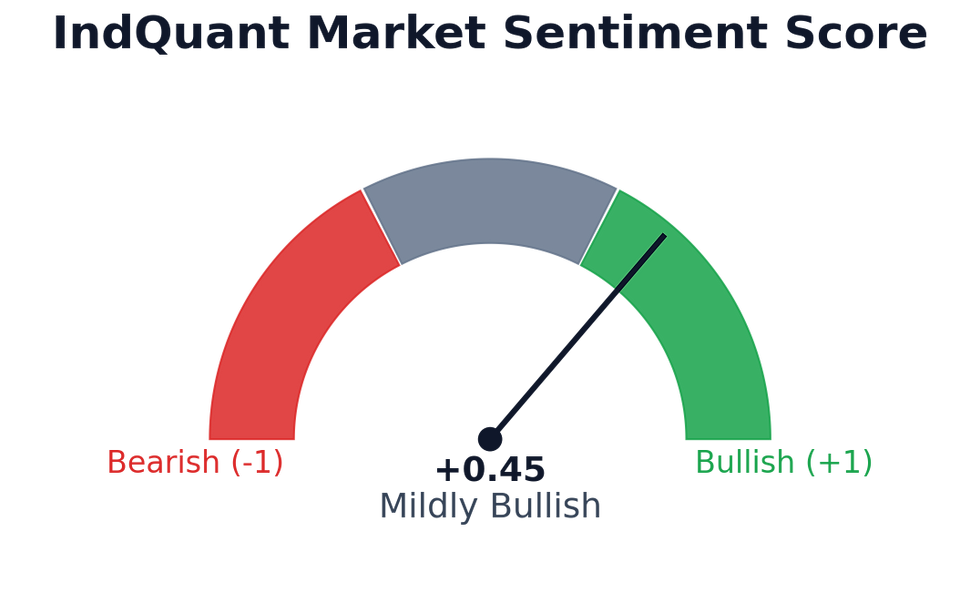
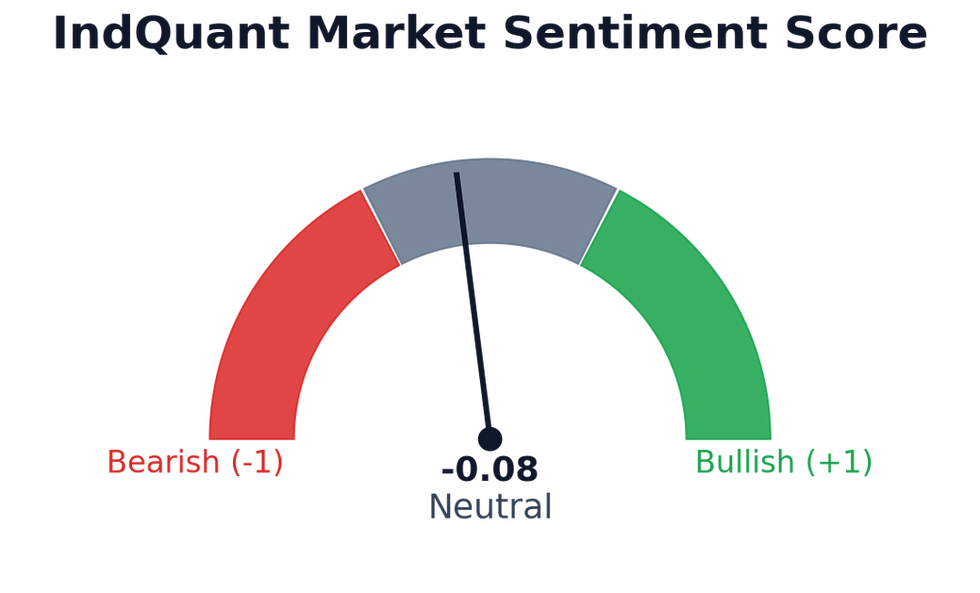
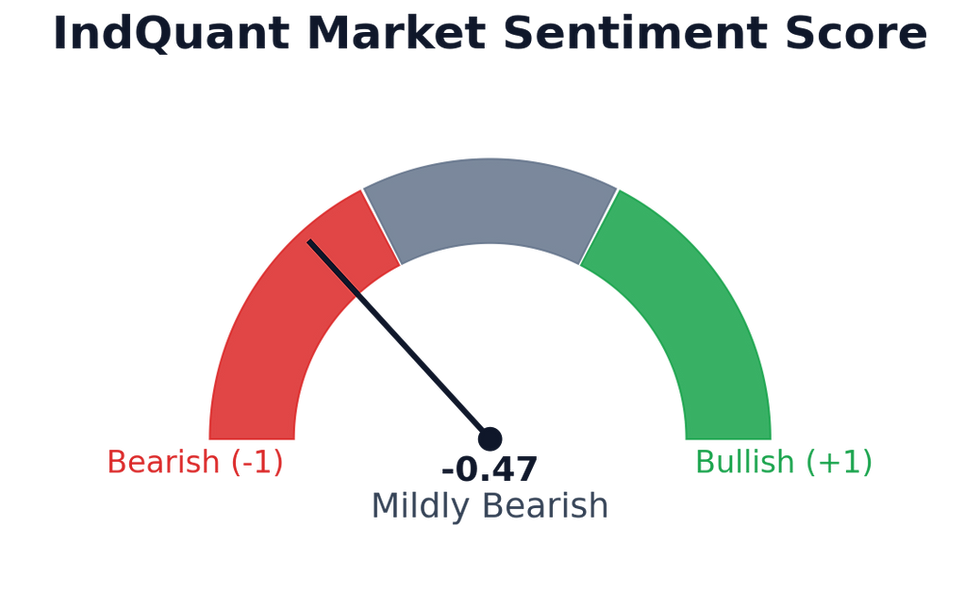
What this sentiment is measuring. We score 16 distinct dimensions of market sentiment, covering broad market direction, key sectors (banking, IT, auto and manufacturing, pharma), global cues, FII / DII flows, currency and commodities, regulatory stance across India and major foreign jurisdictions, and risk indicators. Each dimension is given a score from −1 (strongly bearish) to +1 (strongly bullish), paired with a 0 to 1 confidence weight that reflects how much supporting evidence the model found. The overall score shown in the dial is a confidence-weighted blend of all dimensions on the same −1 to +1 scale.
What data is used. The analysis draws on Indian and global financial news, regulatory and policy feeds from India as well as major foreign jurisdictions, and market news from global exchanges. News items are filtered for freshness and relevance before being scored, so the picture reflects what the market is reading and reacting to right now.
Limitations. This article is not investment advice and not a recommendation to buy, sell, or hold any security. The output is best treated as a structured attribute set — useful as one input among many when building your own prediction models or sense-checking your own view, not as a forecast on its own.
Comments