Nifty at 52-Week Lows: Five Forces Shaping Your Friday Open
Based on market data as of 07:05 IST on 09 October 2026.
At a glance
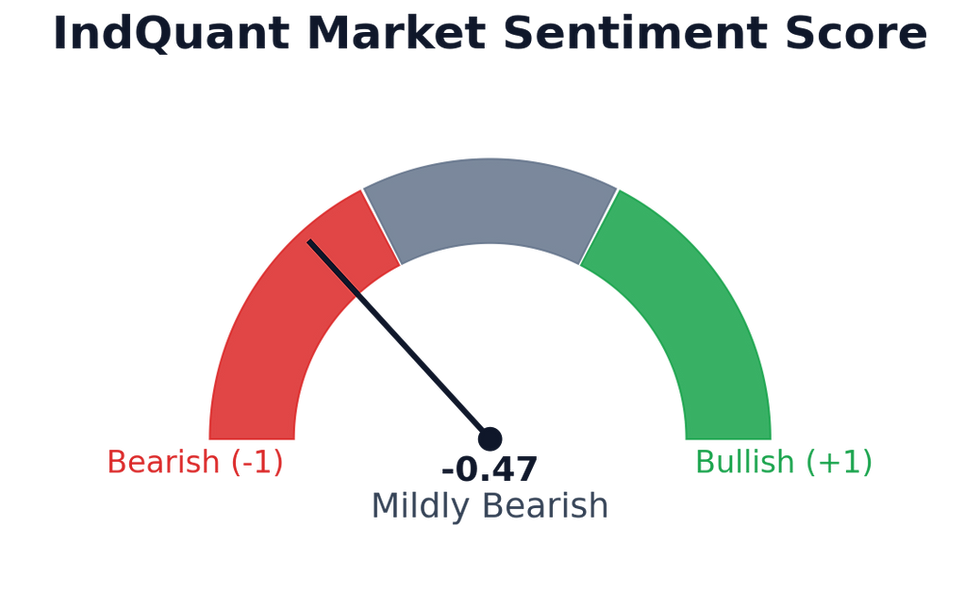
Nifty closed at a 52-week low of 22,179 yesterday; Gift Nifty is up ~115 points this morning, suggesting a modest gap-up open — but the broader backdrop remains bearish at -0.47.
Brent crude is near $104 a barrel on Iran tanker attacks and reports of potential US military action, threatening India's import bill and inflation outlook.
TCS (Tata Consultancy Services) posted a strong 15% year-on-year profit rise, but Infosys and Wipro ADRs (American Depositary Receipts — US-listed shares of Indian companies) fell ~3% on H-1B green card crackdown fears, keeping IT sentiment mixed.
The setup
Friday, October 9, 2026 begins with Indian equity markets at a delicate crossroads. Overnight, Wall Street slipped, Asian markets opened marginally lower, and crude oil stayed stubbornly elevated — all while the Nifty 50 sits at its lowest point in a year. The Gift Nifty (a futures contract traded in Gujarat's GIFT City that acts as an early indicator for the Nifty 50 open) is pointing to a small recovery at the open, but that relief may be short-lived. This morning's briefing is about understanding the five forces already in motion before the 9:15 AM bell rings — so you can watch the session with clear eyes rather than react to noise.
Top 5 sentiment drivers
Geopolitical risk premium. Reports of potential US military strikes on Iran ahead of US midterm elections have pushed Brent crude to $104 a barrel, while Iran's attacks on tankers in the region add further supply-side fear. Separately, Japan-US military exercises near Taiwan are raising Indo-Pacific risk flags, and India's Chief Economic Adviser has flagged geopolitics as a key risk to India's growth outlook. This driver is strongly bearish at -0.70.
Risk factors. The risk pile-up is broad and simultaneous: crude at $104, the RBI (Reserve Bank of India) holding its repo rate (the rate at which the RBI lends to commercial banks) at 5.50% with a further 50 basis-point hike expected by March 2027, US 30-year mortgage rates at 7.40% signalling sustained global rate stress, and elevated Taiwan tensions. This cluster of risks earns a strongly bearish score of -0.65.
Currency and commodity impact. Brent crude near $104 — driven by Iran tanker attacks and a hurricane threatening US oil supply — directly pressures India's CAD (Current Account Deficit, the gap between what India earns and spends in foreign exchange). The rupee was already sliding toward a record low before RBI intervention stepped in. Conflicting signals from Morgan Stanley, which trimmed oil forecasts on US-Iran peace deal hopes, add uncertainty. This driver is moderately bearish at -0.60.
FII/DII flow sentiment. FII (Foreign Institutional Investor) outflows remain a persistent drag: GQG Partners alone has sold ₹24,400 crore (approximately ₹244 billion) worth of Indian equities in 2026, including ITC and Adani group shares. The India-US bond yield spread — the gap between Indian and US government bond returns — is near a 22-year low, reducing the incentive for foreign money to stay in India. DII (Domestic Institutional Investor) buying is providing a partial cushion, but it has not fully offset the selling pressure. This driver is moderately bearish at -0.55.
Market volatility outlook. With Nifty at a 52-week low of 22,179 and Sensex down 1,045 points in the previous session, India VIX (Volatility Index — a measure of expected market turbulence, often called the "fear gauge") is likely elevated. The Nifty 50 chart shows a weak short-term structure, and multiple simultaneous risk factors are amplifying swings. Gift Nifty's +115-point signal may soften the opening gap-down, but it does not resolve the underlying pressure. This driver is moderately bearish at -0.55.

Sectors in focus
Banking. Mildly bearish at -0.40 — the RBI's hawkish repo rate stance at 5.50%, with more hikes on the horizon, squeezes NIM (Net Interest Margin, the difference between what banks earn on loans and pay on deposits). FII outflows from the sector and the RBI placing two co-operative banks under restrictions add to the cautious tone this morning.
IT. Mildly bearish at -0.25 — TCS's Q2 net profit rising 15% year-on-year to ₹13,884 crore and AI (Artificial Intelligence) revenue crossing $3 billion are genuine positives. However, sequential revenue growth of just 0.2% — the slowest in three years — and a ~3% fall in Infosys and Wipro ADRs on US H-1B green card crackdown concerns temper the enthusiasm heading into today's session.
Auto and manufacturing. Mildly bearish at -0.20 — crude at $104 raises input cost concerns for vehicle manufacturers and their component suppliers. On the positive side, GST (Goods and Services Tax) Council reforms easing compliance for small sellers could benefit the auto ancillary ecosystem, and the PLI (Production-Linked Incentive) scheme continues to support manufacturing capex. Net effect: cautious but not alarming.
Pharma and healthcare. Roughly neutral at +0.05 — this is the one sector where the score edges into positive territory, largely on its defensive appeal during a broader selloff. No negative USFDA (US Food and Drug Administration) actions have been reported. US-Iran tensions could theoretically disrupt API (Active Pharmaceutical Ingredient) supply chains from the Middle East, but this risk is not yet materialising. Watch this space as a relative safe harbour today.

Global and macro backdrop
Wall Street closed in the red overnight. The S&P 500 and NASDAQ fell — the NASDAQ dropped 1.25% — weighed down by crude-driven inflation fears, OpenAI revenue concerns, and persistently high US yields. MSCI Asia Pacific (a broad index tracking Asian stocks) edged 0.1% lower in early Friday trade. European stocks also slid on oil-inflation worries.
On the currency front, the rupee was under pressure yesterday before RBI intervention. With crude staying elevated, the rupee's stability will be a key intraday watch. The RBI is also conducting a ₹1,50,000 crore (₹1.5 lakh crore) VRRR (Variable Rate Reverse Repo — a tool the RBI uses to absorb excess cash from the banking system) auction today, reinforcing its liquidity-tightening bias.
On the positive macro side, the GST Council has raised the prosecution threshold to ₹5 crore and introduced automated registration and faster refunds — reforms that ease the compliance burden for small businesses and could support consumption over time.
The ECB (European Central Bank) meeting minutes show eurozone inflation at 3.8%, with at least one ECB member calling for further rate hikes. This reduces the flow of global capital toward emerging markets like India.
Risks to watch
Crude escalation: Any fresh Iran-related headline — new tanker attacks or confirmation of US military action — could push Brent above $104 and trigger a sharp intraday selloff.
Rupee at record low: If RBI support fades and the rupee breaks to a new record low, it would amplify FII outflows and import-cost pressures simultaneously.
RBI VRRR auction outcome: Today's ₹1,50,000 crore liquidity absorption auction could tighten short-term rates further, adding pressure on rate-sensitive sectors like banking and real estate.
FII selling continuation: With the India-US yield spread near a 22-year low and hedging costs rising, there is little structural incentive for FIIs to reverse course quickly.
What to expect as today's session begins
Today's session is likely to open modestly higher — Gift Nifty's +115-point signal provides that small cushion — but the recovery may struggle to hold given the weight of crude prices, FII outflows, and a hawkish RBI. Pharma could attract defensive buying, while banking and IT face headwinds. The key number to watch is whether Nifty can hold above its 52-week low of 22,179 through the session; a sustained breach of that level would be a significant technical signal for market participants to monitor. Keep an eye on crude price updates and any Iran-related news through the day — that single variable has the most power to shift sentiment quickly in either direction.

How to read this
What this sentiment is measuring. We score 16 distinct dimensions of market sentiment, covering broad market direction, key sectors (banking, IT, auto and manufacturing, pharma), global cues, FII / DII flows, currency and commodities, regulatory stance across India and major foreign jurisdictions, and risk indicators. Each dimension is given a score from −1 (strongly bearish) to +1 (strongly bullish), paired with a 0 to 1 confidence weight that reflects how much supporting evidence the model found. The overall score shown in the dial is a confidence-weighted blend of all dimensions on the same −1 to +1 scale.
What data is used. The analysis draws on Indian and global financial news, regulatory and policy feeds from India as well as major foreign jurisdictions, and market news from global exchanges. News items are filtered for freshness and relevance before being scored, so the picture reflects what the market is reading and reacting to right now.
Limitations. This article is not investment advice and not a recommendation to buy, sell, or hold any security. The output is best treated as a structured attribute set — useful as one input among many when building your own prediction models or sense-checking your own view, not as a forecast on its own.

Comments