
India Macro Outlook 2026:
Quantitative Bull, Base, and Bear Cases
Data as of March 2026
Probabilistic assesment of various economic scenarios
India Macro Outlook 2026: Scenario Analysis
The model does not just produce averages. It maps out specific stories. Each of the 25,000 simulated paths is shaped by one major event (a war escalation, a ceasefire, a rate hike, an election surprise) drawn from a library of 47 scenarios. On top of that, persistent background pressures (stagflation, monsoon risk, foreign investor selling) accumulate gradually across all paths with diminishing intensity (the first overlapping pressure hits at full force; the second at 40%; the third at 30%). In 20% of paths, no major event occurs at all, representing the most common real-world outcome where geopolitical noise remains just noise.
Scenario A: Nothing Breaks (~20% of paths)
What happens: No major geopolitical or financial event materialises. Hormuz tension persists at current levels, elections produce no surprise, global macro stays range-bound. Background pressures (stagflation, FII selling, monsoon risk) apply but at reduced intensity.
- Nifty: Flat to −5%. Gradual background pressure without a catalyst.
- Brent: $95–105. Current pricing roughly maintained.
- USD/INR: 96–100. Moderate depreciation from ongoing FII and oil pressure.
- Gold (INR): +5 to +10% in rupee terms.
What happens: A Hormuz ceasefire or partial reopening; global risk appetite recovers; a trade deal materialises; reform momentum picks up. When a positive event fires, the model automatically reduces the intensity of negative background pressures by 45%, reflecting the observation that good news dampens ongoing fears.
Scenario B: Things Get Better (~15–20% of paths)
- Nifty: +15 to +23%. Relief rally plus earnings upgrades.
- Brent: $68–85. Risk premium unwinds sharply.
- USD/INR: 86–94. Rupee strengthens on narrower deficit and FII stabilisation.
- Gold (INR): Flat to negative as safe-haven demand fades.
- GDP: 6.8–7.2% in FY27, supported by capex and consumption.
Scenario C: Things Get Worse (~20–25% of paths)
What happens: Hormuz blockade extends or Saudi Arabia retaliates; FII selling accelerates; a global recession hits; BJP suffers comprehensive state election losses. When severe escalation fires, correlated background pressures are amplified: oil-related background effects intensify by 21% due to correlation between war and energy shocks.
- Nifty: −15 to −20%. Broad-based de-rating; mid/small-caps hit harder.
- Brent: $140–187. India's import bill surges by $40–70 billion.
- USD/INR: 105–112. Approaching the model's historical maximum.
- Gold (INR): +15 to +24%. USD gold plus rupee depreciation compound.
- Inflation: 6.5–8.0%. RBI forced to hold or tighten despite slowing growth.
Scenario Impact Matrix
Scenario
Prob.
Equities
Brent
USD/INR
Gold
Silver
Type
Hormuz Extended
24%
−15 to −20%
+40 to +90%
105–112
+10 to +24%
+10 to +30%
Event
Ceasefire / Deal
FII Sell-Off
10%
65%
+10 to +20%
−5 to −15%
−15 to −31%
−8 to −15%
Neutral
86–93
+10 to +30%
100–108
−5 to −15%
45%
100–110
+3 to +8%
−5 to −10%
Neutral
Event
Stagflation
Ongoing
Monsoon Deficit
40%
28%
−5 to −10%
Neutral
−15 to −31%
98–105
+5 to +15%
+2 to +5%
+5 to +20%
Global Recession
−15 to −20%
+8 to +20%
Neutral
Ongoing
95–103
−10 to −20%
Ongoing
Event
BJP Election Loss
Risk Recovery
22%
'Event' = one-off shock (exactly one per path); 'Ongoing' = persistent pressure (accumulates across all paths with diminishing intensity). Probabilities are analyst-assigned base values before live sentiment adjustment.
15%
−5 to −12%
+10 to +20%
Neutral
−5 to −15%
97–104
88–94
Neutral
−3 to −8%
Neutral
+5 to +15%
Event
Event
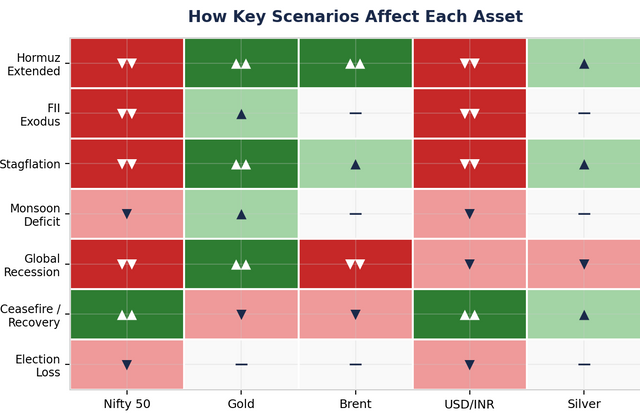
Exhibit 8: Scenario impact heatmap. Dark red = strong negative; dark green = strong positive. The Hormuz extended scenario is the most uniformly negative across equities and the rupee. Ceasefire/recovery is the mirror image.
How Risks Compound: Feedback Loops
The most critical feature of India's risk landscape is that shocks do not act in isolation. The model captures three self-reinforcing feedback loops that amplify individual shocks into cross-asset cascades:
- Oil → Rupee → Inflation → RBI constraint: A $20/bbl crude spike widens the trade deficit, which weakens the rupee by 3–5%, which adds 50–80 basis points to consumer inflation, which prevents the RBI from cutting rates, removing the monetary policy cushion that would normally soften the blow to equities.
- Equity fall → Foreign selling → Rupee → Wider deficit → More selling: When equities fall more than 15%, the model amplifies the probability of foreign investor selling by 1.4x, reflecting the institutional risk-off cascade. This self-reinforcing loop is the reason the P5 tail (−20%) is deeper than any single scenario would produce alone.
- Monsoon failure → Food inflation → RBI pause → Equity drag: Agricultural distress adds 150–250 basis points to food prices, forcing the RBI into a hawkish hold even as growth decelerates. This is the classic stagflationary bind that Indian markets have experienced during previous El Niño episodes.
Stress Test: Worst-Case Compound Scenario
Hormuz extended blockade + FII acceleration + Monsoon failure: When the model simulates a Hormuz blockade with amplified oil-related background pressures (+21% from correlation), combined with the FII selling feedback loop and monsoon failure, the results are: Brent at $140–187, Nifty −15 to −20%, INR at 105–112, gold +15 to +24% in INR terms. For an unhedged USD-based investor, the compound effect (equity loss plus currency loss) produces a total return of −25 to −36% over nine months.
These compound scenarios are rare (3–5% combined probability) but they explain why the tail of the distribution is deeper than any individual scenario would suggest.
About This Report
India Macro Outlook 2026 Published: March 2026
Produced by: Investopic Research
Engine: IndQuant DDPM Quantitative Model
Coverage: Nifty 50, Gold, Silver, Brent Crude, USD/INR
Scenarios: 47 | Simulated paths: 25,000 | Horizon: 9 months
Disclosure
This Study is produced for informational and analytical purposes only. It does not constitute investment advice, a recommendation, or a solicitation to buy, sell, or hold any financial instrument. The analysis relies on quantitative models with inherent limitations including limited historical parallels, static probability assignment, and single-window training. Past performance does not guarantee future results. All scenario probabilities, distributional outputs, and sensitivity estimates are model-implied and subject to uncertainty. No content in this report should be interpreted as a buy, sell, hedge, or allocation recommendation. All observations describe model-implied distributional characteristics; they do not prescribe portfolio action. Data as of March 2026.