
India Macro Outlook 2026:
Asset by Asset Outlook
Data as of March 2026
Quantitative Probabilistic Forecast of how the assets could look like
The section covers the key insights generated by the model. Nifty 50 median return is -2% with a wide range of -20% to +23%. Gold is the stability anchor at +1% median in USD terms, approximately +10% in INR. Brent Crude is the most asymmetric variable at +7% median but +90% in extreme scenarios. USD/INR weakens to a median of 102.1 in most paths.
What this section covers
Asset-by-Asset Outlook
The table below summarises the full distributional output: not just the central estimate but the range and direction of asymmetry for each asset. The model generates 25,000 independent price paths over 189 trading days. Each path is shaped by a specific scenario and tested against seven economic consistency rules (for example: if crude surges 50%, the rupee must weaken. Paths that violate this are discarded and redrawn).
Distributional Forecast Summary (9-Month Horizon)
Asset
Current
P5 (Bear)
Median
P95 (Bull)
Mean
Tilt
Nifty 50
Gold (COMEX)
23,306
$4,513.9
18,575 (−20%)
$3,842.7 (−15%)
22,822 (−2%)
$4,581.4 (+1%)
28,666 (+23%)
$71.89
$51.77 (−28%)
$71.17 (−1%)
$5,605.1 (+24%)
23,032 (−1%)
Silver (COMEX)
$4,632.1 (+3%)
Bearish
Brent Crude
$98.76
$68.40 (−31%)
$105.9 (+7%)
$111.2 (+55%)
$75.26 (+5%)
Bullish
93.86
85.49 (−9%)
102.1 (+9%)
$187.5 (+90%)
$114.5 (+16%)
Neutral
USD/INR
112.2 (+20%)
100.8 (+7%)
Bullish
INR Weak
P5 = 5th percentile (bear case); P95 = 95th percentile (bull case). Mean = probability-weighted average across all 25,000 paths. Nifty 50 represents Indian equities (Sensex omitted due to 0.999 correlation). For USD/INR, positive % = rupee weakening.
Equities: Mild Bearish Tilt, Wide Range
The model places Indian equities in a state of mild bearish drift. Nifty median −2%, mean −1%, with a 43-percentage-point range from worst case (−20%) to best case (+23%). This is not a crash forecast. It reflects the combined weight of several pressures (stagflation risk, foreign investor selling, election uncertainty), partially offset by a meaningful set of positive scenarios (ceasefire, global recovery) and the 20% of paths where no major shock hits at all.
The shape of the distribution matters. The downside extends deeper (−20%) than the upside (+23%), and the mean sits below the median. This is the signature of a distribution that leans left. In practical terms: the most likely outcome is a modest decline, but the tail risks are asymmetric: large losses are more probable than equivalently large gains.
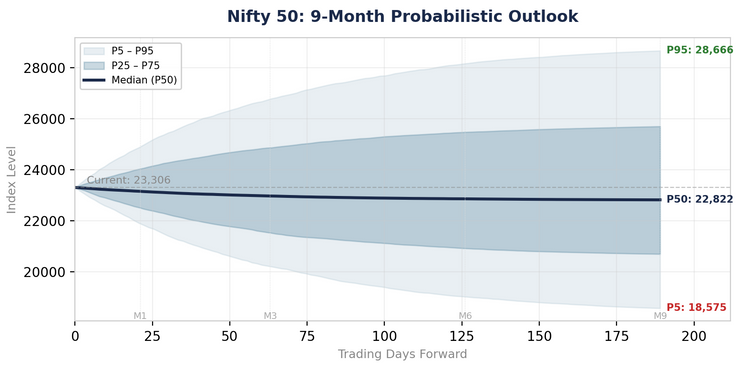
Exhibit 3: Nifty 50 nine-month probabilistic outlook. The shaded bands show the range of outcomes from P5 (bear) to P95 (bull). The median path drifts mildly below current levels. The fan widens over time as uncertainty compounds.
Crude Oil: The Variable That Drives Everything Else
Brent crude has the widest and most lopsided distribution of any asset in the study: P5 at $68 (−31%), median at $106 (+7%), P95 at $187.5 (+90%). The extreme upside comes from the Hormuz scenarios (five possible outcomes for how the ongoing crisis evolves, ranging from ceasefire to extended blockade to Saudi retaliation). The downside reflects demand destruction in a global recession or a swift peace deal.
Why this matters for India: the country imports roughly 85% of its crude oil. The median path adds an estimated $15–20 billion to the annual import bill. The extreme case ($187.5) would be the worst oil shock since 2008. The model enforces the economic logic that when crude surges above 50% of current levels, the rupee must weaken, because the import bill mechanically widens the current account deficit.
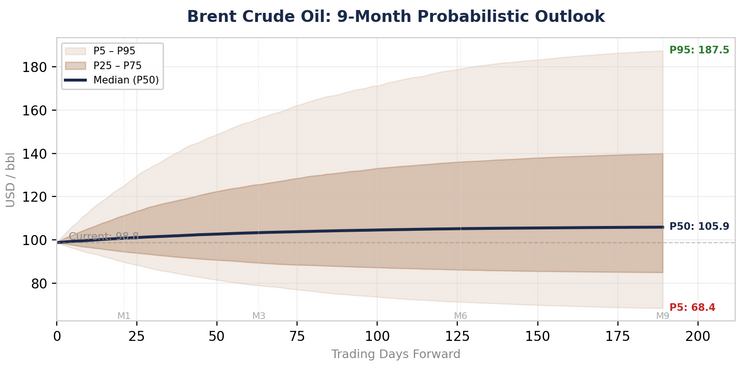
Exhibit 4: Brent Crude nine-month outlook. The massive right tail reflects Hormuz blockade and Saudi retaliation scenarios. The left tail captures ceasefire and global recession paths. This is the single most consequential variable for Indian markets.
The Rupee: Pressure from Three Directions
The rupee distribution centres on a median of 102.1 (+9% depreciation from 93.86). Three forces push in the same direction: higher oil import costs widen the trade deficit; persistent foreign investor selling (65% probability) reduces demand for Indian assets; and the narrowing gap between Indian and US interest rates makes rupee-denominated investments less attractive to carry traders.
One notable improvement from the previous model: the best-case scenario (P5 at 85.49, or 9% rupee appreciation) now includes meaningful upside paths driven by ceasefire and global risk recovery. The worst case (P95 at 112.2, +20% depreciation) approaches the model's hard limit, calibrated to the observation that no post-2000 episode has produced rupee depreciation beyond ~18%.
The RBI's $600+ billion reserve buffer provides a meaningful policy backstop. The model captures the characteristic RBI intervention pattern: active defence for 2–3 weeks (drawing down reserves at $3–5 billion per week), followed by structural weakness once reserve depletion or interest rate differentials become binding. This is modelled through a 45-day event window for the rupee, longer than the 20-day window for equities.
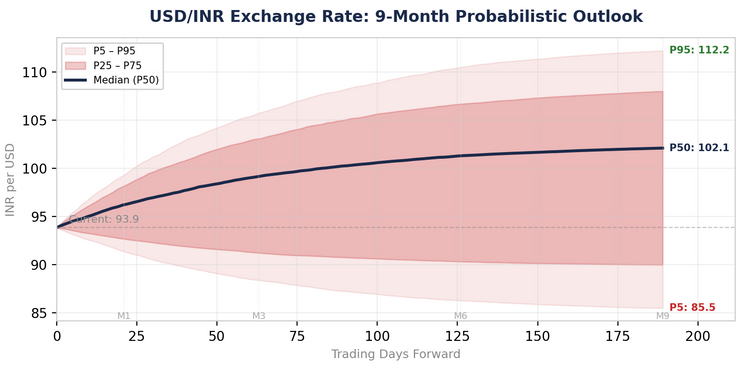
Exhibit 5: USD/INR nine-month outlook. The median path trends toward ~102. The upside scenario (rupee appreciation to ~86) reflects ceasefire paths. The downside approaches the model's hard cap near 117.
Gold: The Anchor Asset
Gold exhibits the most favourably skewed distribution: median +1%, mean +3%, P95 +24%, against a P5 of −15% (driven by scenarios where interest rates rise sharply, making non-yielding gold less attractive). The total P5-to-P95 range of 39 percentage points is narrower than equities, crude, or silver.
The model enforces a critical economic rule: when equities fall more than 20%, gold must hold or rise, reflecting the well-documented safe-haven rotation in Indian portfolios during crises. This rule is triggered in roughly 13% of simulated paths and contributes to gold's positive skew.
The return profile strengthens materially in rupee terms. A 1% USD gold return combined with 9% rupee depreciation produces approximately +10% in INR terms, with notably lower volatility than equities. This makes gold the natural stability anchor in the current macro environment.
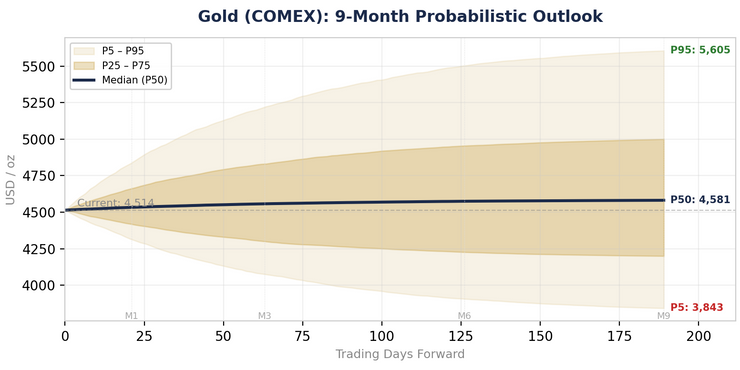
Exhibit 6: Gold (COMEX) nine-month outlook. The narrow band and upward skew are distinctive. The P95 at $5,605 reflects crisis safe-haven flows; the P5 at $3,843 reflects rate-hike scenarios.
Silver: The Widest Distribution
Silver has the widest distributional range in the entire study: 83 percentage points from P5 (−28%) to P95 (+55%). The median is near-flat at −1%, reflecting the tug-of-war between silver's two identities: as an industrial metal (which falls in recessions) and as a precious metal and inflation hedge (which rises in stagflationary crises).
The model imposes two safety constraints on silver: a ceiling at 1.8x current levels ($129/oz would exceed the all-time record of $49.51 from 2011 in inflation-adjusted terms) and a floor at 0.55x (a >45% drop from this base has no precedent outside COVID/Taper Tantrum). These rules affect roughly 21% and 2% of paths respectively, tightening what would otherwise be an even more extreme distribution.

Exhibit 7: Silver (COMEX) nine-month outlook. The near-flat median masks extreme tails in both directions: stagflation-driven upside vs. recession-driven downside.
About This Report
India Macro Outlook 2026 Published: March 2026
Produced by: Investopic Research
Engine: IndQuant DDPM Quantitative Model
Coverage: Nifty 50, Gold, Silver, Brent Crude, USD/INR
Scenarios: 47 | Simulated paths: 25,000 | Horizon: 9 months
Disclosure
This Study is produced for informational and analytical purposes only. It does not constitute investment advice, a recommendation, or a solicitation to buy, sell, or hold any financial instrument. The analysis relies on quantitative models with inherent limitations including limited historical parallels, static probability assignment, and single-window training. Past performance does not guarantee future results. All scenario probabilities, distributional outputs, and sensitivity estimates are model-implied and subject to uncertainty. No content in this report should be interpreted as a buy, sell, hedge, or allocation recommendation. All observations describe model-implied distributional characteristics; they do not prescribe portfolio action. Data as of March 2026.