Sensex Crashes 712 Points as Hormuz Conflict Sends Crude Surging 4%
- Jul 13
- 6 min read
Based on market data as of 10:05 IST on 13 July 2026.
At a glance
Sensex is down 712 points to 76,857 and Nifty is testing the 24,000 support level as of 10:05 IST, with India VIX (volatility index, a measure of market fear) spiking 10% in a single session.
The trigger is a sharp escalation in the US-Iran conflict over the Strait of Hormuz, pushing Brent crude up 4.10% to $79.13 per barrel and the rupee down 39 paise to 95.72 per US dollar.
IT stocks are the lone bright spot — HCL Technologies is up 0.61% ahead of its Q1FY27 results — but this is a small island of green in a broadly red market.

The setup
About 45 minutes into the session, the direction is unmistakably bearish and the selling is broad-based. Yesterday's cautious tone has turned into an outright risk-off move this morning, driven almost entirely by a single geopolitical shock: the US-Iran standoff over the Strait of Hormuz, a narrow waterway through which roughly 20% of the world's oil passes. That one development has rippled into crude oil prices, the rupee, inflation expectations, and investor sentiment all at once. The early session is not showing any meaningful recovery attempt — markets are in price-discovery mode, trying to find a floor.
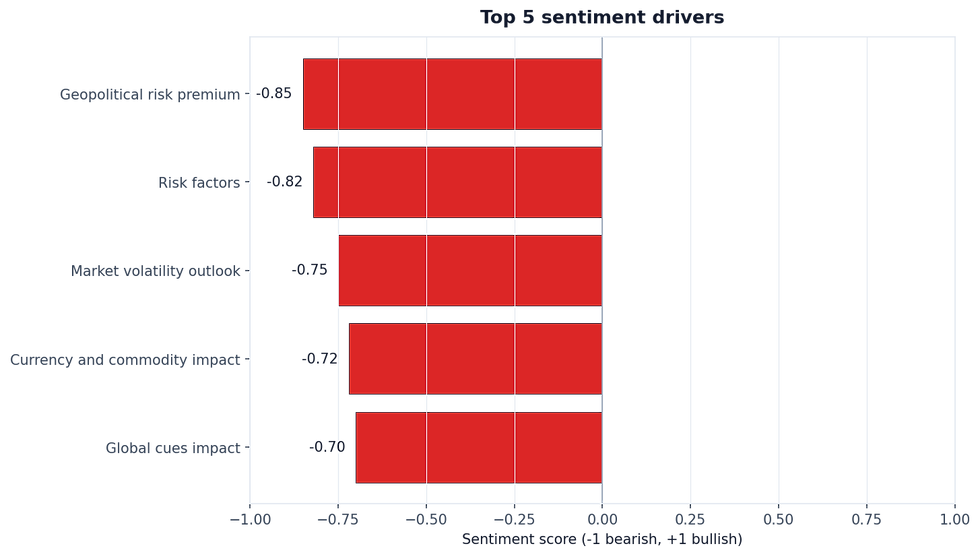
Top 5 sentiment drivers
Geopolitical risk premium. The US-Iran conflict over control of the Strait of Hormuz — a critical oil chokepoint — is the single biggest driver of today's selloff, scoring strongly bearish at -0.85. Brent crude has surged 4.10% to $79.13 per barrel on supply disruption fears, and the NATO Summit's tone of "more of a warning than an escape" signals that military escalation risk is not going away quickly. Tokyo-Beijing tensions over the South China Sea are adding a second layer of Asian risk-off sentiment.
Risk factors. Multiple risks are hitting simultaneously, making this a strongly bearish session at -0.82. India VIX (the market's fear gauge) is up 10% in a single morning, Nifty is testing the psychologically important 24,000 support level, the rupee is at 95.72 per US dollar, and the monsoon deficit has widened to 18% — adding an agricultural stress layer on top of the geopolitical shock. When this many risk factors align at once, markets typically stay under pressure until at least one resolves.
Market volatility outlook. The VIX jumping 10% in one session is a significant signal, making the volatility outlook strongly bearish at -0.75. A spike of this size typically means options traders are aggressively buying put options (contracts that profit when markets fall) as a hedge, which can amplify downward moves. The Sensex dropping over 700 points confirms that this is not routine intraday noise — it reflects a genuine repricing of risk.
Currency and commodity impact. The rupee's 39-paise drop to 95.72 per US dollar is scoring bearish at -0.72, and it compounds the crude oil problem significantly. India imports roughly 85% of its crude oil needs, so a weaker rupee means the import bill rises in rupee terms even beyond the dollar-price increase. Gold fell ₹2,000 per 10 grams and silver dropped ₹5,400 per kilogram, suggesting markets are pricing in rate-hike bets rather than a flight to safety in precious metals.
Global cues impact. Global cues are decisively negative this morning, scoring bearish at -0.70. The Hormuz conflict is the dominant signal, but the NATO Summit's cautious tone and Tokyo-Beijing South China Sea friction are reinforcing a broader risk-off mood across Asian markets. FII (Foreign Institutional Investor) outflows from emerging markets like India tend to accelerate during geopolitical shocks of this nature, and the rupee's weakness is an early indicator that this is already happening.
Sectors in focus
Banking. Mildly bearish at -0.60 — Bank Nifty is being dragged lower by the broad selloff, and rising crude oil above $79 per barrel is stoking inflation fears that could delay RBI (Reserve Bank of India) rate cuts, which banks had been counting on. The SBI Funds Management IPO anchor book being 20 times subscribed, attracting names like BlackRock and ADIA, is a small positive for the SBI ecosystem but is not enough to offset the macro headwinds this morning.
IT. Mildly bullish at +0.20 — IT is the only sector showing green in an otherwise red market. HCL Technologies is up 0.61% to ₹1,171.20 ahead of its Q1FY27 results announcement today. IT stocks tend to act as a defensive play during rupee weakness because these companies earn revenues in US dollars, so a weaker rupee actually boosts their reported rupee earnings. Investors appear to be rotating into IT as a partial hedge.
Auto & Manufacturing. Mildly bearish at -0.30 — the crude oil surge to $79.13 per barrel raises input costs for automakers, and the rupee's weakness at 95.72 per US dollar increases the cost of imported components. The one forward-looking positive is a new report projecting India's EV (electric vehicle) sales to surge 12-fold to 3 crore (30 million) units by 2032, but that is a long-term story and offers no near-term cushion against today's cost pressures.
Pharma & Healthcare. Essentially neutral at +0.05 — there are no specific USFDA (US Food and Drug Administration) actions or major company announcements from Sun Pharma, Cipla, or Dr Reddy's in this early session. Pharma typically holds up better than cyclical sectors during geopolitical selloffs due to its defensive nature, and that pattern appears to be playing out today, though the broad market pressure is keeping even defensives from making meaningful gains.

Global and macro backdrop
The global backdrop is uniformly negative this morning. Brent crude at $79.13 per barrel — up 4.10% in a single session — is the sharpest commodity signal. The NATO Summit's tone suggests the US-Iran standoff is not a short-term flare-up. Asian markets are also under pressure from Tokyo-Beijing tensions over the South China Sea.
On flows, the rupee's 39-paise drop to 95.72 per US dollar is a strong indicator that FII (Foreign Institutional Investor) money is exiting Indian equities and moving into safe-haven assets like the US dollar. DII (Domestic Institutional Investor) activity has not yet provided a visible floor. The SBI Funds Management IPO attracting anchor investors like BlackRock, ADIA, GIC, and Capital Group at 20 times subscription is a positive signal for domestic institutional appetite, but it is a primary-market event and does not directly support secondary-market prices today.
Rising crude oil also complicates India's CAD (Current Account Deficit — the gap between what India earns from exports versus what it spends on imports). A higher oil import bill widens the CAD, which puts further pressure on the rupee, creating a feedback loop that markets are clearly pricing in this morning.
Risks to watch
Strait of Hormuz escalation: Any news of physical disruption to oil tanker traffic could push Brent crude significantly higher, deepening the selloff.
Nifty 24,000 breach: If Nifty closes below 24,000, it could trigger stop-loss selling (automatic sell orders placed to limit losses) from traders, accelerating the decline.
Monsoon deficit widening: The 18% deficit is already adding food inflation risk; a further deterioration could complicate RBI's rate-cut path.
HCL Tech Q1 results: Due today — a miss on earnings or guidance could remove the one sector providing relative stability right now.
What this means for the rest of today's session
The early session tone suggests the rest of the day will remain volatile and under pressure unless there is a de-escalation signal from the US-Iran front — which is not currently visible. The Nifty 24,000 level is the key number to watch: a hold above it could stabilise sentiment in the afternoon session, while a breach could invite a second wave of selling. IT stocks and their Q1 results are the only near-term catalyst that could provide a partial offset. For now, the market is in reactive mode, and the direction is being set entirely by events outside India's control.

How to read this
What this sentiment is measuring. We score 16 distinct dimensions of market sentiment, covering broad market direction, key sectors (banking, IT, auto and manufacturing, pharma), global cues, FII / DII flows, currency and commodities, regulatory stance across India and major foreign jurisdictions, and risk indicators. Each dimension is given a score from −1 (strongly bearish) to +1 (strongly bullish), paired with a 0 to 1 confidence weight that reflects how much supporting evidence the model found. The overall score shown in the dial is a confidence-weighted blend of all dimensions on the same −1 to +1 scale.
What data is used. The analysis draws on Indian and global financial news, regulatory and policy feeds from India as well as major foreign jurisdictions, and market news from global exchanges. News items are filtered for freshness and relevance before being scored, so the picture reflects what the market is reading and reacting to right now.
Limitations. This article is not investment advice and not a recommendation to buy, sell, or hold any security. The output is best treated as a structured attribute set — useful as one input among many when building your own prediction models or sense-checking your own view, not as a forecast on its own.


Comments