Sensex Climbs 452 Points at Open, but Hormuz and TCS Keep Rally Fragile
- Jul 9
- 6 min read
Based on market data as of 10:04 IST on 09 July 2026.
At a glance
Sensex is up ~452 points to 76,998 and Nifty has rebounded ~137 points, partially recovering yesterday's worst session in three months.
US military strikes on Iran have brought Hormuz shipping to a near standstill, sending crude oil futures sharply higher — a direct headwind for India as a major oil importer.
TCS (Tata Consultancy Services) is trading near a 6-year low ahead of its Q1 FY27 (April–June 2026) results due today, keeping the IT sector under pressure even as Auto and Manufacturing stocks attract buyers.

The setup
About 45 minutes into today's session, the market is doing something specific: it is recovering, but not convincingly. The Sensex and Nifty opened higher after yesterday's sharp selloff, and early breadth — the number of stocks advancing versus declining — looks reasonably healthy. But two live fault lines are visible right now. The first is geopolitical: US strikes on Iran have effectively frozen shipping through the Strait of Hormuz, the world's most critical oil chokepoint, and crude futures are surging in response. The second is sector-specific: TCS, India's largest IT company by market cap, is dragging the Nifty lower even as other pockets of the market try to recover. The early-session picture is one of selective buying in domestic-facing sectors and cautious avoidance of IT names.
Top 5 sentiment drivers
Geopolitical risk premium. US military strikes on Iran have brought Hormuz shipping to a near standstill — roughly 20% of the world's traded oil passes through this strait — and crude oil futures are surging as a result. The Russia-Ukraine war is adding a second layer of disruption, forcing Graphite India to shut its German division. This driver is strongly bearish at -0.65, and it is the single biggest weight on today's recovery.
Risk factors. The cluster of concurrent risks — Hormuz oil supply shock, European operational disruptions for Indian companies, monsoon-related building collapses in Delhi and Pune, TCS near 6-year lows, and Trump's unpredictable posture at the NATO summit — is keeping overall sentiment fragile. Taken together, these risks score a firmly bearish -0.50, meaning the market's recovery is happening despite the risk backdrop, not because it has cleared.
Auto and manufacturing outlook. This is the brightest spot in today's early session. Honda India has announced a capacity expansion to 80 lakh (8 million) units per year by 2028, creating 3,800 jobs — a concrete capex commitment. The government's decision to waive basic customs duty on key electronics manufacturing components is adding fuel, and major global fashion brands are reportedly expanding India production capacity. This driver is mildly bullish at +0.55 and is one of the reasons the broader market is holding up.
India regulatory stance. The domestic policy environment is providing quiet but meaningful support. The customs duty waiver on electronics components directly strengthens the PLI (Production-Linked Incentive) and Make in India frameworks. PM Modi's active push for a CECA (Comprehensive Economic Cooperation Agreement) with Australia signals continued FDI (Foreign Direct Investment) attraction efforts. India's first hydrogen train is set to be flagged off next week. No adverse RBI (Reserve Bank of India) or SEBI (Securities and Exchange Board of India) actions have emerged. This driver is mildly bullish at +0.55.
IT sector sentiment. TCS fell 1.87% to ₹2,017.50 in early trade, hovering near a 6-year low. TCS and Infosys have reportedly lost around 55% of their peak market value. Q1 FY27 results from TCS are due today, making this a live binary event — the numbers could either stabilise the sector or accelerate the selloff. India's largest mutual fund scheme is buying both stocks on dips, which provides some floor, but the sector remains a clear drag on the Nifty rebound. This driver is bearish at -0.45.

Sectors in focus
Banking. Mildly bullish at +0.40 — the sector is participating in the broader recovery, and the stable RBI regulatory stance is providing a calm backdrop. No Bank Nifty-specific data has emerged in this window, but the return of risk appetite post yesterday's selloff is visible in broader market breadth, and a steady INR (Indian Rupee) is supportive.
IT. Bearish at -0.45 — TCS near a 6-year low and Q1 FY27 results due today make this the most watched sector right now. Mutual fund accumulation is providing a partial cushion, but until the earnings numbers land, IT stocks are likely to remain under pressure and act as a drag on index-level gains.
Auto & Manufacturing. The standout sector in early trade, mildly bullish at +0.55. Honda India's capacity expansion announcement, the customs duty waiver on electronics components, and broader Make in India tailwinds are drawing buyers. This sector is currently leading the recovery and offsetting some of the IT-driven weakness.
Pharma. Broadly neutral at +0.10 — no specific pharma catalysts have emerged in this session so far. The sector is likely drifting higher with the broader market recovery. One risk worth noting: a prolonged Hormuz disruption could affect API (Active Pharmaceutical Ingredient) and chemical imports routed through the Middle East, though this is not yet a live market concern today.

Global and macro backdrop
Asian shares are climbing this morning, led by a semiconductor and chip stock rally — a positive cue for tech-linked indices globally. However, the oil price surge from the US-Iran conflict is cutting across that optimism. Crude oil futures are rising sharply as Hormuz shipping grinds toward a standstill, and this is a direct negative for India, which imports roughly 85% of its crude oil needs. A sustained crude spike pressures India's CAD (Current Account Deficit) and the INR.
On commodities, gold has eased to ₹1.43 lakh (₹1,43,000) per 10 grams, and silver has fallen ₹15,000 over four days — suggesting some rotation away from safe-haven assets, though Iran-related inflation concerns remain live. The US regulatory stance is mildly bearish at -0.35, driven not by Fed (US Federal Reserve) rate action — none is expected today — but by the geopolitical unpredictability of US military action and Trump's NATO summit comments.
On FII (Foreign Institutional Investor) and DII (Domestic Institutional Investor) flows, no real-time provisional data is available yet for today's session. Yesterday's sharp selloff suggests FII selling was likely active. DIIs, however, appear to be absorbing pressure — India's largest mutual fund scheme is visibly accumulating TCS and Infosys on dips, signalling strong domestic conviction even in a beaten-down sector.
Risks to watch
TCS Q1 FY27 results today — this is a binary event. Weak guidance or a revenue miss could extend the IT sector selloff and pull the Nifty lower in the afternoon session.
Hormuz escalation — any further deterioration in US-Iran hostilities or a confirmed shipping blockade could send crude sharply higher, pressuring the INR and India's import bill.
India VIX (Volatility Index — measures expected market swings) remains elevated — yesterday was the worst session in three months, and multiple concurrent risk events mean volatility has not fully subsided.
Monsoon disruptions — building collapses in Delhi and Pune signal infrastructure stress; sustained heavy rainfall could affect supply chains and economic activity in affected regions.
What this means for the rest of today's session
The next few hours hinge almost entirely on one event: TCS's Q1 FY27 results. If the numbers surprise positively, IT stocks could reverse sharply and give the Nifty a second leg higher. If they disappoint, the early recovery may fade and the index could give back a significant portion of today's gains. Outside of that, the Auto and Manufacturing sector looks like the steadiest ground in today's market — domestic capex signals are real and policy support is visible. Geopolitical noise from the Gulf will continue to set the ceiling on how far this recovery can run.
How to read this
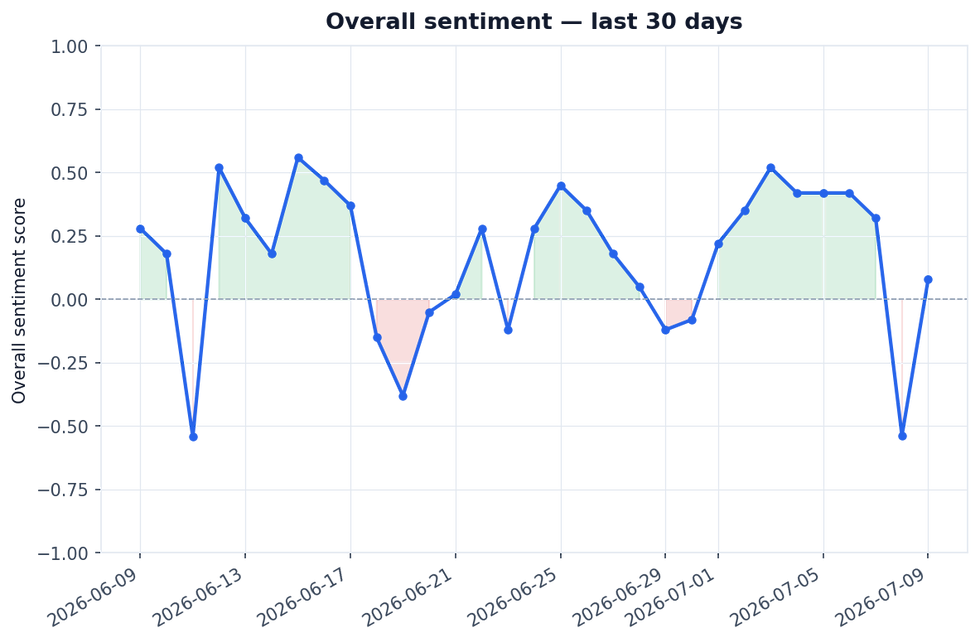
What this sentiment is measuring. We score 16 distinct dimensions of market sentiment, covering broad market direction, key sectors (banking, IT, auto and manufacturing, pharma), global cues, FII / DII flows, currency and commodities, regulatory stance across India and major foreign jurisdictions, and risk indicators. Each dimension is given a score from −1 (strongly bearish) to +1 (strongly bullish), paired with a 0 to 1 confidence weight that reflects how much supporting evidence the model found. The overall score shown in the dial is a confidence-weighted blend of all dimensions on the same −1 to +1 scale.
What data is used. The analysis draws on Indian and global financial news, regulatory and policy feeds from India as well as major foreign jurisdictions, and market news from global exchanges. News items are filtered for freshness and relevance before being scored, so the picture reflects what the market is reading and reacting to right now.
Limitations. This article is not investment advice and not a recommendation to buy, sell, or hold any security. The output is best treated as a structured attribute set — useful as one input among many when building your own prediction models or sense-checking your own view, not as a forecast on its own.


Comments