Nifty Holds Near 24,300 as Crude Shock and Earnings Tug-of-War Plays Out
Based on market data as of 10:05 IST on 17 August 2026.
At a glance
Sensex is down ~305 points and Nifty is near 24,299 in early trade, with geopolitical stress and a ₹95.49 rupee driving the bearish open.
Crude oil at $90 per barrel — triggered by a US threat to blockade Iran — is the single biggest macro headache right now.
Strong Q1 FY27 results from Voltas (+52% profit), Patanjali Foods (+86% profit), and Ashok Leyland (+12% revenue) are limiting the damage and keeping market breadth positive.
The setup
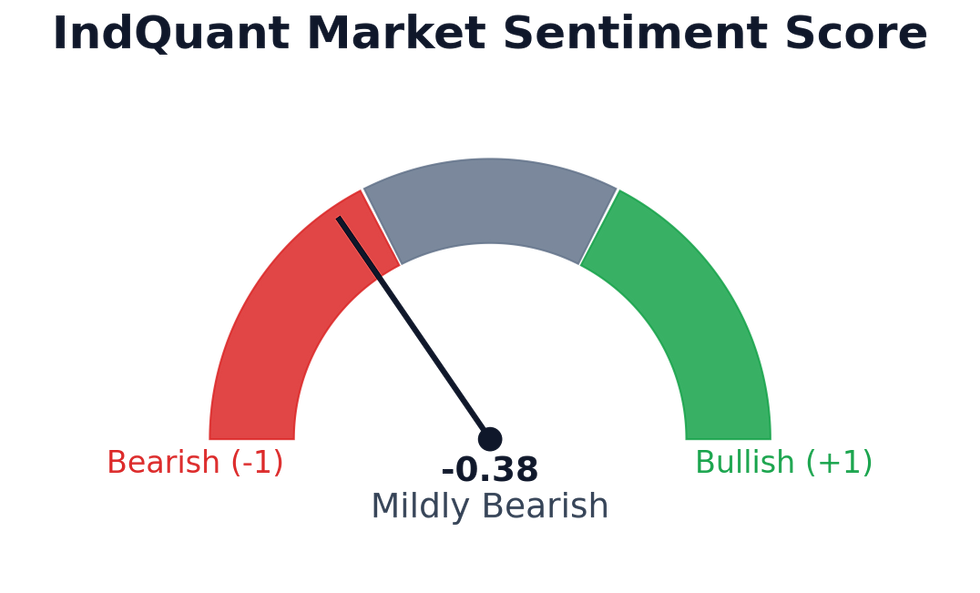
About 45 minutes into Monday's session, Indian markets are navigating a clear tug-of-war. The bears arrived at the opening bell, dragged in by a surge in crude oil prices and a fresh wave of geopolitical tension spanning the Middle East, Eastern Europe, and the Strait of Hormuz. The Nifty 50 — India's benchmark index of the top 50 listed companies — is hovering near 24,299, and the Sensex — the 30-stock index of Bombay Stock Exchange — is down roughly 305 points. Yet the session is not a rout. Positive market breadth (meaning more stocks are rising than falling) and a string of solid corporate earnings are acting as shock absorbers. The overall sentiment score sits at -0.38 on a scale of -1 (fully bearish) to +1 (fully bullish) — moderately bearish, but far from panic territory. Here is what is unfolding right now.
Top 5 sentiment drivers
Geopolitical risk premium. The dominant force in this session is geopolitical — strongly bearish at -0.68. The US has threatened a naval blockade of Iran, raising the risk of a Hormuz strait supply disruption and pushing crude oil to $90 per barrel. Simultaneously, Russia escalated its Ukraine offensive with a missile strike on ArcelorMittal's Kyiv steel plant, and Israeli lawmaker Ben-Gvir's calls for nightly Gaza strikes are adding another layer of Middle East risk. Multiple concurrent flashpoints are driving a classic global risk-off mood, which pulls FII (Foreign Institutional Investor — large overseas funds that invest in Indian markets) flows away from emerging markets like India.
Risk factors. Strongly bearish at -0.62, the risk picture is dominated by the same crude oil spike and geopolitical escalation, but with added texture. The rupee has slipped to 95.49 per US dollar, creating direct cost pressure for import-heavy sectors. The US Federal Reserve's rate path remains uncertain despite Goldman Sachs pushing back against overly hawkish market bets. At the stock level, Schneider Electric Infrastructure has fallen 11% in early trade, a reminder that company-specific shocks are amplifying the broader nervousness today.
Currency and commodity impact. Moderately bearish at -0.55, this driver is closely linked to the first two but deserves its own read. The RBI (Reserve Bank of India — India's central bank) is reportedly intervening by directing state-run banks to sell US dollars, trying to slow the rupee's slide. Crude at $90 per barrel is the dominant negative here — India imports roughly 85% of its oil, so every dollar rise in crude widens the current account deficit and squeezes corporate margins. On the other side, MCX gold is up 0.37% to ₹1,55,079 per 10 grams (about ₹1.55 lakh), offering some relief to commodity-linked plays.
Earnings momentum and corporate health. A clear bright spot — mildly bullish at +0.50. Voltas reported Q1 FY27 PAT (Profit After Tax — net profit) of ₹213 crore, up 52% year-on-year. Patanjali Foods posted PAT of ₹335.7 crore, up 86%, on revenue of ₹11,337 crore (roughly ₹113 billion). Ashok Leyland grew Q1 revenue 12% to ₹13,069 crore at record volumes, with its stock up 3% in early trade. These numbers signal that India's corporate earnings cycle remains healthy even as macro headwinds mount, and they are the primary reason the session has not turned into a broad selloff.
Market volatility outlook. Moderately bearish at -0.45. The India VIX (Volatility Index — a measure of expected near-term market swings; higher means more fear) is being pushed up by the US-Iran tension and the crude spike. Nifty's intraday range is already wide — reports put it anywhere between sub-24,000 and 24,343 — suggesting choppy conditions. Zaggle Prepaid is down 16% and Schneider Electric Infrastructure is down 11%, illustrating that stock-specific volatility is elevated. The saving grace is that positive market breadth is preventing the VIX from spiking to extreme levels.

Sectors in focus
Banking. Mildly bearish at -0.40 — IndusInd Bank has slipped 2.03% in early trade, and the PSU (Public Sector Undertaking — government-owned) Bank index is among the session's early laggards. The rupee at 95.49 creates forex-related stress on bank margins, and elevated crude raises inflation risk, which could eventually pressure NPA (Non-Performing Asset — loans that have gone bad) ratios at public sector lenders.
IT. Mildly bearish at -0.35 — IT stocks are among the contributors to the Sensex decline this morning. German companies cutting US investments by roughly two-thirds in H1 2026 signals caution in global tech spending, which indirectly dampens the revenue outlook for Indian IT exporters. Goldman Sachs' pushback against aggressive Fed rate hike bets could provide medium-term relief for IT valuations, but that is a story for later sessions.
Auto and Manufacturing. Mildly bullish at +0.40 — this is the standout sector in an otherwise red morning. Ashok Leyland's record volume milestone and 3% stock gain are leading the charge. Hero MotoCorp's appointment of a new Chief Strategy Officer signals forward planning. Defence manufacturing names like NIBE (which won a ₹563 crore Indian Army loiter munition contract) and Balu Forge (commercialising ERFB artillery shells) are adding a positive flavour to the broader manufacturing story.
Pharma and Healthcare. Mildly bullish at +0.30 — pharma is playing its traditional defensive role in a risk-off session. Jefferies has raised its price target on Max Healthcare, expecting oncology drug supply issues to resolve by December 2026. Max Healthcare is also seeing a sharp rise in F&O (Futures and Options — derivative contracts used by traders to hedge or speculate) open interest, signalling institutional attention. No new USFDA warning letters or import alerts have emerged in this window, keeping the sector's regulatory backdrop clean.

Global and macro backdrop
The global picture is unambiguously cautious this morning. Japan's GDP (Gross Domestic Product — total economic output) missed forecasts, nudging the Nikkei lower. German corporates have cut US investments by nearly two-thirds in the first half of 2026, citing tariff uncertainty — a sign that global trade fragmentation is deepening. The US-Iran naval blockade threat is the single biggest macro catalyst of the day, with crude at $90 per barrel representing a meaningful inflation shock for oil-importing economies like India.
On flows, Centrum Broking's Jignesh Desai notes that India has been competing for FII attention for 12 months, and the dual headwinds of a weak rupee and high crude are not helping that case today. DII (Domestic Institutional Investor — Indian mutual funds, insurance companies, and similar large local buyers) buying appears to be absorbing some of the selling pressure, which explains the positive breadth. The RBI's currency intervention is a stabilising signal, but the rupee at 95.49 remains a watch point for the rest of the session.
Risks to watch
Crude oil escalation: Any further deterioration in US-Iran relations or a confirmed Hormuz disruption could push crude above $90, worsening India's import bill and inflation outlook.
Rupee slide: If RBI intervention proves insufficient and the rupee weakens past 96, import-heavy sectors — oil marketing companies, airlines, chemicals — could see sharper intraday declines.
Stock-specific shocks: Zaggle Prepaid (-16%) and Schneider Electric Infrastructure (-11%) show that earnings misses or negative news can trigger outsized moves in this environment; watch for more results today.
Fed uncertainty: Any US economic data or Fed commentary that reinforces rate-hike fears could trigger a fresh round of FII outflows from Indian equities.
What this means for the rest of today's session
The early-session read is a moderately bearish day with pockets of resilience — not a collapse, but not a comfortable ride either. The crude oil and geopolitical story will dominate headlines through the afternoon, and any fresh escalation in the Hormuz situation could push the Nifty toward the lower end of its intraday range. Conversely, if more Q1 FY27 earnings beat expectations as the day progresses, DIIs are likely to keep buying dips, which should prevent a sustained break below 24,000. Investors watching the session should keep an eye on the rupee level, the crude price ticker, and the pace of institutional flows — those three variables will determine whether today closes as a mild correction or something steeper.

How to read this
What this sentiment is measuring. We score 16 distinct dimensions of market sentiment, covering broad market direction, key sectors (banking, IT, auto and manufacturing, pharma), global cues, FII / DII flows, currency and commodities, regulatory stance across India and major foreign jurisdictions, and risk indicators. Each dimension is given a score from −1 (strongly bearish) to +1 (strongly bullish), paired with a 0 to 1 confidence weight that reflects how much supporting evidence the model found. The overall score shown in the dial is a confidence-weighted blend of all dimensions on the same −1 to +1 scale.
What data is used. The analysis draws on Indian and global financial news, regulatory and policy feeds from India as well as major foreign jurisdictions, and market news from global exchanges. News items are filtered for freshness and relevance before being scored, so the picture reflects what the market is reading and reacting to right now.
Limitations. This article is not investment advice and not a recommendation to buy, sell, or hold any security. The output is best treated as a structured attribute set — useful as one input among many when building your own prediction models or sense-checking your own view, not as a forecast on its own.


Comments