Nifty Faces Rough Open as Iran Shock Sends Crude Above $79 and VIX Surges 25%
- Jul 9
- 6 min read
Based on market data as of 07:05 IST on 09 July 2026.
At a glance
Trump declared the US-Iran ceasefire "over" overnight, crashing the Dow 500 points and pushing Brent crude above $79 per barrel — the single biggest trigger for today's bearish setup.
India VIX (Volatility Index — a measure of how much fear is priced into the options market) surged 24.85% on July 8, signalling extreme nervousness; GIFT Nifty has partially recovered but the open remains fragile.
The Indian rupee (INR) fell 59 paise to 95.55 against the US dollar — its sharpest single-day drop in recent months — raising import costs and increasing pressure on corporate margins.

The setup
Good morning. Before the opening bell rings at 9:15 AM IST, the picture forming overnight is one of genuine stress. A geopolitical shock — the collapse of the US-Iran ceasefire — has rippled through global markets, lifting crude oil prices, weakening the rupee, and spiking volatility measures to levels not seen in months. GIFT Nifty (the offshore futures contract that trades before Indian markets open and acts as an early indicator of the Nifty 50's direction) has clawed back some losses, offering a sliver of hope for a less-disorderly open. But the underlying drivers remain firmly bearish, and today's session will test how much of yesterday's damage has already been priced in.
Top 5 sentiment drivers
Geopolitical risk premium. Trump's declaration that the US-Iran ceasefire is "over" is the dominant shock of this morning — strongly bearish at -0.80. Hormuz Strait tanker attacks have pushed war insurance costs sharply higher, with shipowners advised to pause voyages through the critical oil chokepoint; Russia's simultaneous full diesel export ban has added a second layer of energy supply disruption that markets are still digesting.
Risk factors. The combined weight of the Iran escalation, a 6% crude surge, and a Dow Jones fall of 500 points (1.46%) has created a broadly risk-off environment — strongly bearish at -0.72. India's plans to import oil from Iran are now in jeopardy, and the Federal Reserve's (Fed — the US central bank) June meeting minutes, released on July 8, revealed that some officials considered an immediate rate hike in response to Iran-driven inflation fears, adding policy uncertainty on top of geopolitical stress.
Market volatility outlook. India VIX surging 24.85% in a single session is a regime-shift signal — strongly bearish at -0.70. When VIX spikes this sharply, options premiums (the cost of buying protection against price swings) expand, making hedging expensive and often forcing leveraged traders to reduce positions. GIFT Nifty's partial overnight recovery suggests the open may not be as severe as yesterday's close, but elevated VIX means intraday swings in either direction can be wide.
Currency and commodity impact. The INR's 59-paise fall to 95.55 per US dollar is the sharpest single-day depreciation in recent memory — bearish at -0.65. A weaker rupee raises the cost of every barrel of crude India imports, squeezes margins for companies with dollar-denominated debt, and can trigger FII (Foreign Institutional Investor — large overseas funds that buy and sell Indian stocks) outflows as returns in dollar terms shrink. Brent crude above $79 per barrel compounds this pressure directly on oil marketing companies and the broader economy.
US regulatory stance. The FOMC (Federal Open Market Committee — the Fed's rate-setting body) minutes from its June 16–17 meeting, released yesterday, showed officials are split between holding rates steady and hiking them — mildly-to-moderately bearish at -0.55. A rate hike scenario would strengthen the US dollar further, weaken the INR, and likely trigger FII outflows from emerging markets including India. No India-specific trade action from the USTR (US Trade Representative) is imminent, so that front remains quiet for now.

Sectors in focus
Banking. Mildly bearish at -0.30 — private banks are expected to report roughly 10% year-on-year PAT (Profit After Tax) growth for Q1, which is a positive signal, but India's 10-year government bond logged its worst single day in three months yesterday as yields rose on Iran fallout, compressing NIMs (Net Interest Margins — the difference between what banks earn on loans and pay on deposits). An undersubscribed RBI (Reserve Bank of India) VRR (Variable Rate Reverse Repo — a tool the RBI uses to absorb or inject liquidity) auction, with only ₹665 crore (6.65 billion rupees) allotted against ₹25,000 crore (250 billion rupees) notified, points to tight system liquidity.
IT. Mildly bearish at -0.35 — TCS (Tata Consultancy Services) reports its Q1 results today, and the street expects flat sequential revenue growth with cautious management commentary on client spending. NASDAQ fell overnight on Iran-driven risk-off sentiment, which typically weighs on Indian IT stocks that trade at a premium to global peers. An Asian semiconductor rally provides a partial offset, but the TCS outlook will set the tone for the broader IT sector this week.
Auto and manufacturing. Mildly bearish at -0.25 — Tata Motors unveiled an ambitious FY31 plan targeting $100 billion in revenue and a 20% passenger vehicle market share, which is a long-term positive. However, crude above $79 per barrel raises input costs across the auto supply chain, and the INR at 95.55 inflates the cost of imported components. Maruti Suzuki is on the pre-market watchlist; watch for any management commentary on demand trends.
Pharma. The lone bright spot — mildly bullish at +0.15. Torrent Pharma has hit a 52-week high, rallying 25% in a single month, and the sector is showing relative outperformance against the broader market selloff. Natco Pharma is flagged in pre-market focus. Pharma's domestic revenue base and limited crude exposure make it a relative safe harbour on days when energy and currency pressures dominate.

Global and macro backdrop
Overnight, the Dow Jones Industrial Average fell 500 points (1.46%) and S&P 500 futures dropped 0.8% after Trump's Iran announcement. Asian markets are showing a mixed-to-partial recovery this morning, led by a chip and semiconductor rally — Alibaba surged 12% in Hong Kong on AI-related optimism. However, Brent crude remains elevated above $79 per barrel, and Russia's full diesel export ban has pushed European diesel margins to a record $60.17 per barrel, adding inflationary pressure globally.
On FII/DII (Domestic Institutional Investor — Indian mutual funds, insurance companies, and similar large domestic buyers) flows, the picture is mixed. India's US Treasury holdings have fallen to $181 billion — a six-year low — suggesting a broader reserve diversification toward gold. On the positive side, 2.5 million new demat accounts (accounts needed to hold shares electronically) were added in June, the highest since February, indicating strong retail investor participation. SEBI (Securities and Exchange Board of India) has amended FPI (Foreign Portfolio Investor) registration fee rules to require rupee payment of ₹2.3 lakh (230,000 rupees), a minor procedural change but one that adds a small friction point for new foreign registrations.
Risks to watch
Hormuz escalation: Any further tanker attacks or a formal blockade of the Hormuz Strait — through which roughly 20% of global oil passes — could push crude well above $80 per barrel and trigger a second leg of selling.
Fed rate hike signal: If Fed officials make public statements reinforcing the hawkish minority view from the FOMC minutes, expect the US dollar to strengthen further and the INR to come under additional pressure.
TCS guidance: A weak Q1 outlook or a cut in deal pipeline guidance from TCS this afternoon could drag the entire IT index lower and weigh on Nifty, given IT's large index weight.
VIX staying elevated: If India VIX does not cool from its 24.85% spike, options market participants may continue to reduce risk, amplifying intraday moves in both directions.
What this means for today's session
Today's open is likely to be volatile and cautious. GIFT Nifty's partial recovery suggests the market may not gap down as sharply as yesterday's close implied, but the underlying drivers — elevated crude, a weak rupee, a spiking VIX, and Fed uncertainty — have not resolved overnight. Pharma may offer relative stability, while IT will be closely watched around TCS results. Traders and investors should brace for wide intraday swings, and the first hour of trade will be critical in signalling whether the market is finding a floor or preparing for another leg lower.
How to read this
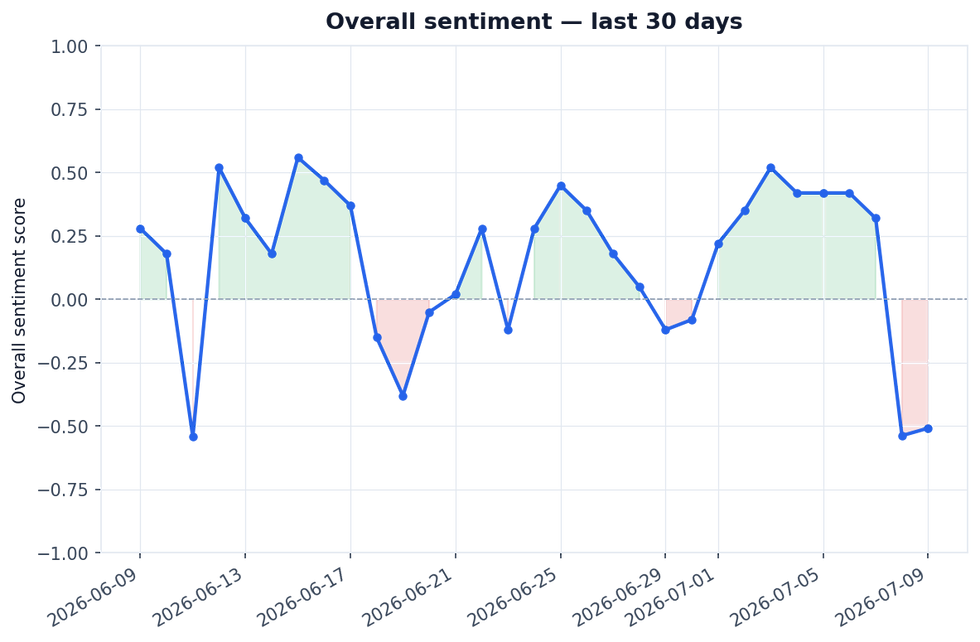
What this sentiment is measuring. We score 16 distinct dimensions of market sentiment, covering broad market direction, key sectors (banking, IT, auto and manufacturing, pharma), global cues, FII / DII flows, currency and commodities, regulatory stance across India and major foreign jurisdictions, and risk indicators. Each dimension is given a score from −1 (strongly bearish) to +1 (strongly bullish), paired with a 0 to 1 confidence weight that reflects how much supporting evidence the model found. The overall score shown in the dial is a confidence-weighted blend of all dimensions on the same −1 to +1 scale.
What data is used. The analysis draws on Indian and global financial news, regulatory and policy feeds from India as well as major foreign jurisdictions, and market news from global exchanges. News items are filtered for freshness and relevance before being scored, so the picture reflects what the market is reading and reacting to right now.
Limitations. This article is not investment advice and not a recommendation to buy, sell, or hold any security. The output is best treated as a structured attribute set — useful as one input among many when building your own prediction models or sense-checking your own view, not as a forecast on its own.


Comments