Nifty Eyes Cautious Open as Hormuz Tensions and Crude Near $90 Cloud Monday
Based on market data as of 07:04 IST on 17 August 2026.
At a glance
Nifty 50 closed at 24,366 after three consecutive weekly losses; F&O (Futures & Options — derivative contracts used to hedge or speculate) analysis puts today's range at 24,150–24,600.
Brent crude is near $88.52 per barrel and approaching $90 on tanker attacks in West Asia, while the RBI (Reserve Bank of India) is actively defending the rupee at 95.45 per US dollar.
India Inc's strongest revenue growth in 9–15 quarters and a successful $56.8 billion FCNR(B) (Foreign Currency Non-Resident (B) — a deposit scheme for NRIs that brings foreign exchange into India) inflow offer partial offsets to the macro headwinds.
The setup
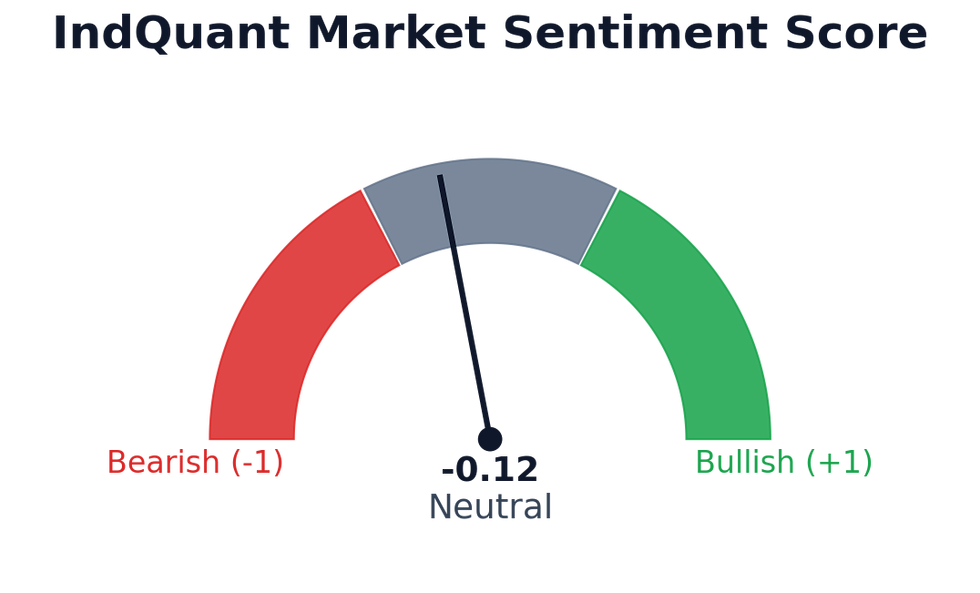
Monday, August 17 begins with Indian investors waking up to a world that is a little more unsettled than it was on Friday. Overnight, Asian markets opened mixed, the dollar softened slightly as bets on another US Federal Reserve rate hike eased, and European equities snapped a four-week winning streak after oil prices climbed. Closer to home, the Strait of Hormuz — the narrow waterway through which roughly 20% of the world's traded oil passes — remains a flashpoint, and that single fact is casting a long shadow over today's session. The overall sentiment score sits at -0.12, which translates to cautious-to-mildly-bearish: not a panic, but not a morning to expect fireworks either.
Top 5 sentiment drivers
Geopolitical risk premium. The Strait of Hormuz is the single biggest market conversation this week — tanker attacks in West Asia are pushing Brent crude toward $90, the US is reportedly planning unprecedented economic isolation of Iran, and China has signalled its civilian ships should be ready for wartime use, raising Taiwan Strait anxiety as a secondary risk. This driver scores strongly bearish at -0.55, and multiple analyst reports flag it as the primary market mover for the week ahead.
Risk factors. Beyond the Hormuz headline, a cluster of macro risks is compounding the caution: India's current account deficit (the gap between what the country earns from and spends on the rest of the world) widened sharply to -$6.2 billion in June 2026 from a surplus of +$1.2 billion a year ago, and global central banks are signalling a more aggressive rate-hike path than markets had priced in. This bundle of risks scores moderately bearish at -0.45.
Currency and commodity impact. The RBI is actively intervening to hold the rupee at 95.45 per US dollar — a level analysts describe as a significant stress point — while Brent crude at $88.52 per barrel threatens to widen India's import bill further and pressure the current account deficit even more. Gold near $4,400 per troy ounce reflects a global risk-off mood. This driver scores moderately bearish at -0.40.
Market volatility outlook. India VIX (Volatility Index — a measure of how much the market expects prices to swing; higher means more fear) is expected to stay elevated today, given three straight weekly Nifty losses and unresolved geopolitical uncertainty. F&O data places Nifty in a 24,150–24,600 band with no clear breakout direction, and options premiums are likely to be priced higher than usual. This driver scores mildly bearish at -0.35.
Earnings momentum and corporate health. Not everything is gloomy: India Inc just posted its fastest revenue growth in 9–15 quarters, with aggregate corporate profits up 16% year-on-year. Standout results include Muthoot FinCorp's (a non-banking financial company) Q1 profit nearly tripling to ₹705 crore (7.05 billion rupees) and Patanjali Foods' gross profit jumping 35% to ₹1,521 crore (15.21 billion rupees). Margin pressure from rising energy costs is a watch item, but the earnings backdrop scores mildly bullish at +0.30 and provides a genuine counterweight to the macro gloom.

Sectors in focus
Banking. Mildly bearish at -0.15 — the RBI (Reserve Bank of India) slapped a ₹59.20 lakh (5.92 million rupee) penalty on IndusInd Bank for deposit-rate and securitisation violations, and bank holidays for SBI, HDFC, and ICICI of up to three days this week will reduce trading liquidity; on the positive side, analysts cite a 41% upside target for HDFC Bank and Muthoot FinCorp's strong quarterly profit.
IT. Mildly bearish at -0.30 — TCS (Tata Consultancy Services) suffered the largest market-cap erosion among the top-five firms in last week's ₹1 lakh crore (1 trillion rupee) collective wipeout, and rising global bond yields continue to pressure high-PE (Price-to-Earnings ratio — a valuation measure) tech stocks; the partial offset is easing Fed rate-hike bets and AI-sector optimism around Anthropic's reported IPO (Initial Public Offering) at a $190–200 billion valuation.
Auto & Manufacturing. Mildly bullish at +0.20 — Ashok Leyland's Q1 revenue grew 10% to ₹10,750 crore (107.5 billion rupees), signalling steady commercial-vehicle demand, while Japan deepening defence manufacturing ties with India and the Reliance-Rolls-Royce AMCA engine partnership point to medium-term order flow; cement companies, however, face margin pressure from rising fuel costs despite double-digit volume growth.
Pharma & Healthcare. Mildly bullish at +0.25 — analysts are explicitly favouring healthcare as a key positioning theme alongside financials and capex plays; 3M India's healthcare segment drove 19% revenue growth, and EPL's beauty and cosmetics division delivered 25% topline growth with guidance raised to 16–18%; no adverse USFDA (US Food and Drug Administration) actions are in the current news cycle, making this sector a relative safe harbour today.

Global and macro backdrop
Asian markets are opening mixed this morning. The US dollar has dipped slightly after weak US retail sales data reduced the probability of an imminent Federal Reserve rate hike — a mild positive for emerging-market currencies including the rupee. However, European equities snapped a four-week rally on Friday as oil prices climbed, signalling that energy costs are now overriding the rate-relief narrative in developed markets.
On the domestic macro front, the RBI conducted a ₹2 lakh crore (2 trillion rupee) VRRR (Variable Rate Reverse Repo — a tool the RBI uses to absorb excess cash from the banking system) auction today to manage liquidity. The central bank's FCNR(B) swap facility has attracted $56.8 billion in forex inflows, providing a meaningful buffer for the rupee. SEBI (Securities and Exchange Board of India) is also proposing digital onboarding for FPIs (Foreign Portfolio Investors — overseas funds that buy Indian stocks and bonds) and a penalty rationalisation framework, both of which are modest long-term positives for market access.
FII (Foreign Institutional Investor — large overseas funds) and DII (Domestic Institutional Investor — mutual funds, insurance companies, and similar Indian institutions) flow data from the previous session shows a mildly negative FII tilt (-0.10 score), suggesting overseas funds are not yet stepping in as buyers at current levels. Gold at $4,400 per troy ounce reinforces the global risk-off tone.
Risks to watch
Crude oil spike: Any fresh tanker attack or escalation in Iran-US tensions could push Brent above $90 intraday, widening India's import bill and pressuring both the rupee and oil-sensitive sectors.
Rupee at 95.45: If RBI intervention fails to hold this level, imported inflation (inflation caused by costlier imports) could rise, complicating the central bank's rate path.
Global central bank hawkishness: Surprise rate-hike signals from the US Fed or European Central Bank could trigger a bond-yield spike and a fresh round of FII selling in Indian equities.
Nifty below 24,150: A break below the lower end of the F&O-derived support band could trigger stop-losses (pre-set orders to limit losses) and accelerate selling pressure.
What this means for today's session
Today's session is likely to open flat-to-slightly-lower and stay range-bound within the 24,150–24,600 band unless a fresh geopolitical headline — positive or negative — shifts the narrative. The strong earnings season provides a floor, but the Hormuz risk premium, elevated crude, and a stressed rupee mean buyers will remain selective. Investors may find relative stability in pharma and domestic-consumption names, while IT and energy-import-heavy sectors could face the most pressure. Keep an eye on the RBI's VRRR auction outcome and any midday crude-price moves — those two data points are likely to set the tone for the afternoon trade.

How to read this
What this sentiment is measuring. We score 16 distinct dimensions of market sentiment, covering broad market direction, key sectors (banking, IT, auto and manufacturing, pharma), global cues, FII / DII flows, currency and commodities, regulatory stance across India and major foreign jurisdictions, and risk indicators. Each dimension is given a score from −1 (strongly bearish) to +1 (strongly bullish), paired with a 0 to 1 confidence weight that reflects how much supporting evidence the model found. The overall score shown in the dial is a confidence-weighted blend of all dimensions on the same −1 to +1 scale.
What data is used. The analysis draws on Indian and global financial news, regulatory and policy feeds from India as well as major foreign jurisdictions, and market news from global exchanges. News items are filtered for freshness and relevance before being scored, so the picture reflects what the market is reading and reacting to right now.
Limitations. This article is not investment advice and not a recommendation to buy, sell, or hold any security. The output is best treated as a structured attribute set — useful as one input among many when building your own prediction models or sense-checking your own view, not as a forecast on its own.


Comments