Nifty Enters October Bruised: What to Expect as Markets Open Today
Based on market data as of 07:05 IST on 01 October 2026.
At a glance
Nifty 50 just closed its worst month in 8 years, falling 6.1% in September, and Gift Nifty (the offshore futures contract that signals how Indian markets will open) is pointing to a gap-down start of roughly 30 points.
Russia's nuclear warning to NATO, rising crude oil prices, and continued FII (Foreign Institutional Investor) selling are the dominant headwinds as the session begins.
A silver lining exists: US core PCE (Personal Consumption Expenditure — the Fed's preferred inflation gauge) came in softer than expected at 3.0%, and domestic SIP (Systematic Investment Plan) inflows hit a record ₹32,297 crore (₹32,297 crore = approximately $3.9 billion) in August, giving DIIs (Domestic Institutional Investors) firepower to absorb some selling.

The setup
October 1 arrives with the weight of a difficult September still fresh. Nifty 50's 6.1% monthly decline — its steepest in eight years — has reset sentiment to cautious, and the overnight global backdrop has not offered a clean rescue. Asian markets are opening mixed, geopolitical noise is loud, and crude oil prices remain elevated, which is a direct pressure point for India's import bill and current account. The morning's task for investors is not to predict a bottom, but to understand the forces at play before the opening bell rings at 9:15 AM IST.
Top 5 sentiment drivers
Geopolitical risk premium. Russia issued a nuclear warning to NATO over Kaliningrad access — one of the most significant escalation signals in recent months — while the Xi-Trump summit has added uncertainty around Taiwan and regional stability. A partial offset comes from the US-Iran peace deal, which has led Morgan Stanley to lower its oil price forecasts, but the net geopolitical score remains strongly bearish at -0.60. Crisil has separately flagged war-related risks for Indian exporters in diamonds, specialty chemicals, and polyester textiles.
Risk factors. Multiple stress signals are converging simultaneously: the Russia-NATO escalation, an intensifying US-China WTO (World Trade Organization) compliance dispute, and Crisil's warning that the RBI (Reserve Bank of India) could raise rates by 50 basis points (bps — one basis point equals 0.01%) to manage inflation. Adding to the unease, CCC-rated US corporate bond spreads (the extra yield demanded on the riskiest US company debt) have crossed 1,000 bps for the first time since the 2023 banking crisis, signalling global credit stress. This driver scores strongly bearish at -0.55.
Market volatility outlook. Nifty's worst monthly fall in eight years has effectively shifted the market into an elevated-volatility regime. India VIX (Volatility Index — a measure of expected near-term market swings, often called the "fear gauge") is likely to open higher. Gift Nifty's 30-point pre-market decline confirms the cautious mood. Multiple BSE 100 blue-chips, including Wipro and PB Fintech, are sitting at 52-week lows, which can trigger further stop-loss selling. This driver scores moderately bearish at -0.50.
Currency and commodity impact. Brent crude is rising even as Saudi Arabia's export recovery adds supply — a net negative for India's CAD (Current Account Deficit, the gap between what India earns and spends in foreign exchange). The US dollar retreated overnight after the softer PCE print, which provides mild support to the Indian rupee (INR). Indian government bonds are at two-year lows amid rate-hike expectations, and the 364-day T-bill yield stands at 6.18%. Overall, this driver scores moderately bearish at -0.40.
Pharma and healthcare sentiment. The BSE Hospitals Index fell 5% in the previous session after the Supreme Court raised pointed questions about steep cancer drug markups — a regulatory intervention that creates pricing uncertainty across the hospital sector. Max Healthcare and Apollo Hospitals were among the top Nifty losers. Crisil has also flagged war-related supply chain risks for specialty chemicals that feed into pharma inputs. With no positive USFDA (US Food and Drug Administration) pipeline news to offset these pressures, this driver scores moderately bearish at -0.40.

Sectors in focus
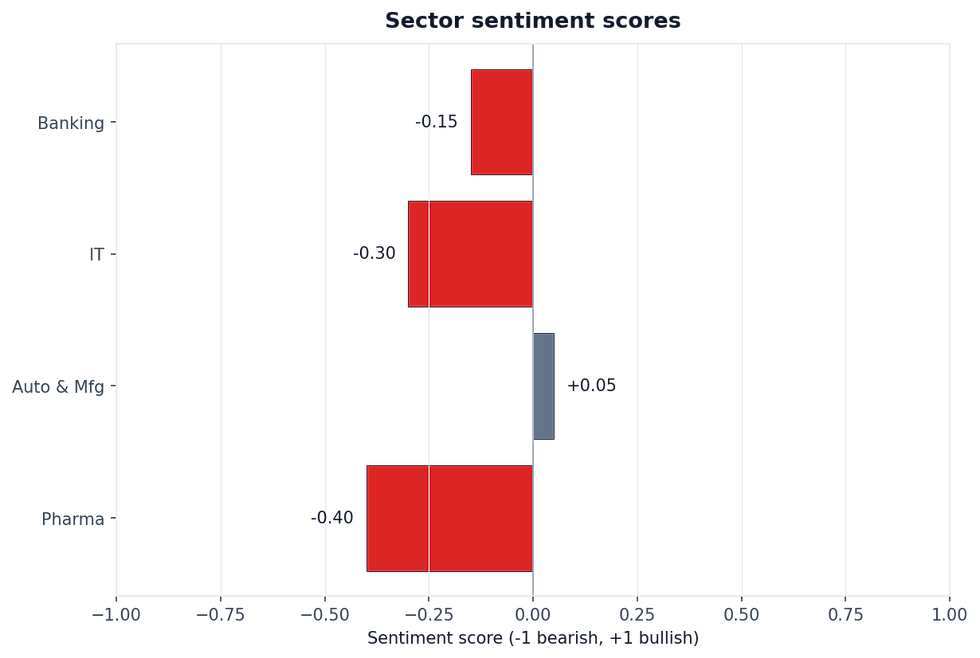
Banking. Mildly bearish at -0.15 — the sector carries relative resilience today. Macquarie forecasts 18% EPS (Earnings Per Share) growth for Indian banks in FY28, and non-food bank credit grew a healthy 18.8% year-on-year in August 2026. However, Indian bonds at two-year lows and Crisil's rate-hike warning could pressure net interest margins (the difference between what banks earn on loans and pay on deposits) if the RBI acts.
IT. Moderately bearish at -0.30 — Infosys, TCS, and Wipro are all at multi-year lows, with Wipro among the eight BSE 100 stocks that hit fresh 52-week lows recently. The Q2 FY27 results season is approaching, with TCS and HCL Tech earnings as key catalysts. Accenture's upcoming results are worth watching — historically, Accenture's quarterly print moves the Nifty IT index by 2% or more. The Nasdaq's mild overnight gain on softer US PCE data is a small positive but unlikely to reverse the sector's near-term pressure.
Auto and Manufacturing. Marginally bullish at +0.05 — the only sector with a positive tilt today. The government's notification of CAFE-III (Corporate Average Fuel Economy) norms, which set stricter fuel-efficiency standards for vehicles, has been welcomed by the auto industry as a pathway for ethanol-based mobility and consumer choice. Crisil notes that a weak monsoon is unlikely to dent rural demand significantly, which supports auto volumes. Rising crude prices remain a watch item for consumer sentiment.
Pharma. Moderately bearish at -0.40 — the Supreme Court's cancer drug markup query has cast a regulatory shadow over hospital stocks specifically, but the ripple effect on broader pharma sentiment is real. Supply chain risks from geopolitical disruptions and the absence of fresh USFDA approvals mean there is no near-term catalyst to lift the sector. Investors in hospital stocks should watch for any further court developments during the session.
Global and macro backdrop
US markets closed on a mixed note overnight. The softer core PCE reading of 3.0% (versus the 3.3% consensus expectation) has reduced the probability of a Fed (US Federal Reserve) rate hike in October, which is a mild positive for emerging markets (EMs) like India. The US dollar index eased slightly, offering the rupee a degree of breathing room.
Asian markets are opening cautiously mixed. China's PBOC (People's Bank of China) and CSRC (China Securities Regulatory Commission) have made no major new stimulus announcements, limiting any positive spillover to EM sentiment. The US-China WTO dispute is escalating, raising trade diversion risks for Indian exporters.
On the FII/DII flow front, FII selling was the primary driver of September's sharp decline. SEBI (Securities and Exchange Board of India) and the RBI have jointly launched the India Market Access portal to simplify FPI (Foreign Portfolio Investor) onboarding — a structural positive, though its impact will be felt over months, not days. DII support remains anchored by record SIP inflows of ₹32,297 crore in August, giving domestic funds ammunition to buy on dips.
The RBI conducted a ₹2,00,000 crore (₹2 lakh crore) VRRR (Variable Rate Reverse Repo — a tool the RBI uses to absorb excess liquidity from the banking system) auction, signalling active liquidity management. New bulk FD (Fixed Deposit) rules also come into effect today, October 1, enhancing transparency in the banking system.
Risks to watch
Russia-NATO escalation: Any further statements or military movements around Kaliningrad could spike global risk-off sentiment sharply and push crude higher.
RBI rate hike signal: Crisil's 50 bps rate hike warning — if echoed by RBI commentary — could pressure rate-sensitive sectors like banking, real estate, and NBFCs (Non-Banking Financial Companies).
US-China trade dispute: An escalation at the WTO could disrupt global supply chains and reduce demand for Indian IT and specialty chemical exports.
CCC bond spread contagion: If US high-yield credit stress (spreads above 1,000 bps) deepens, it could trigger a broader global risk-off wave that accelerates FII outflows from India.
What to expect today
Today's session is likely to open under mild pressure, with Gift Nifty's 30-point gap-down setting the early tone. Expect volatility to be elevated, particularly in IT, pharma/hospital stocks, and any names with high FII ownership. DII buying on dips — backed by strong SIP flows — may limit the downside, but a clean recovery rally would need a positive trigger that is not yet visible in the pre-market data. The first hour of trade, between 9:15 AM and 10:15 AM IST, will be the key window to watch for whether selling pressure intensifies or stabilises.
How to read this
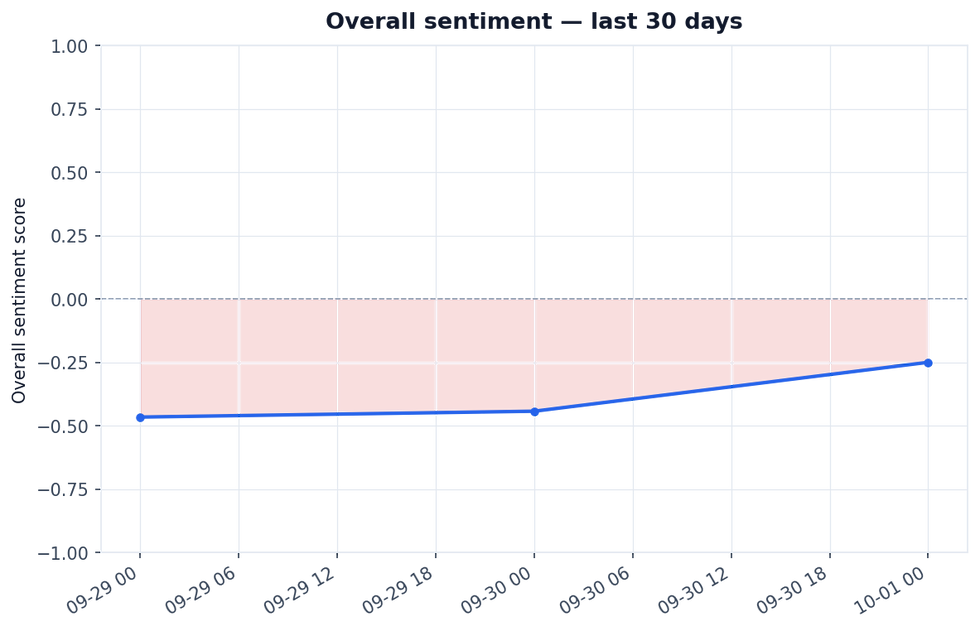
What this sentiment is measuring. We score 16 distinct dimensions of market sentiment, covering broad market direction, key sectors (banking, IT, auto and manufacturing, pharma), global cues, FII / DII flows, currency and commodities, regulatory stance across India and major foreign jurisdictions, and risk indicators. Each dimension is given a score from −1 (strongly bearish) to +1 (strongly bullish), paired with a 0 to 1 confidence weight that reflects how much supporting evidence the model found. The overall score shown in the dial is a confidence-weighted blend of all dimensions on the same −1 to +1 scale.
What data is used. The analysis draws on Indian and global financial news, regulatory and policy feeds from India as well as major foreign jurisdictions, and market news from global exchanges. News items are filtered for freshness and relevance before being scored, so the picture reflects what the market is reading and reacting to right now.
Limitations. This article is not investment advice and not a recommendation to buy, sell, or hold any security. The output is best treated as a structured attribute set — useful as one input among many when building your own prediction models or sense-checking your own view, not as a forecast on its own.


Comments