Nifty Below 24,300 at Midday: Crude, Iran, and CPI Keep Bears in Charge
- Aug 12
- 6 min read
Based on market data as of 13:04 IST on 12 August 2026.
At a glance
Nifty 50 is trading below 24,300 and Sensex is down over 600 points as of lunchtime, with the overall sentiment score at -0.44 — firmly bearish.
US-Iran geopolitical tensions are the dominant force, pushing Brent crude (the international oil benchmark) close to $90 per barrel and the rupee to 95.42 against the US dollar.
The afternoon session hinges on two unknowns: whether Hormuz tensions ease, and what the US CPI (Consumer Price Index — a key inflation measure) print signals about the Fed's (US Federal Reserve's) next move.

The setup
Midway through Wednesday's session, the morning selloff has not reversed — it has simply paused. Nifty opened weak on overnight GIFT Nifty signals flagging US-Iran war risk, slid below 24,300, and has since been consolidating near those lows rather than bouncing. The Sensex intraday swing has already crossed 600 points, a sign that traders are not yet comfortable adding risk. New information since the open has not helped: Iran's comments have dashed hopes of a Hormuz deal, US Treasury yields have dipped (reflecting global risk-off sentiment), and the rupee has slipped further. With roughly 2.5 hours left in the session, the market is in a holding pattern — watching crude, watching the dollar, and waiting for the US CPI data that arrives after Indian market hours.
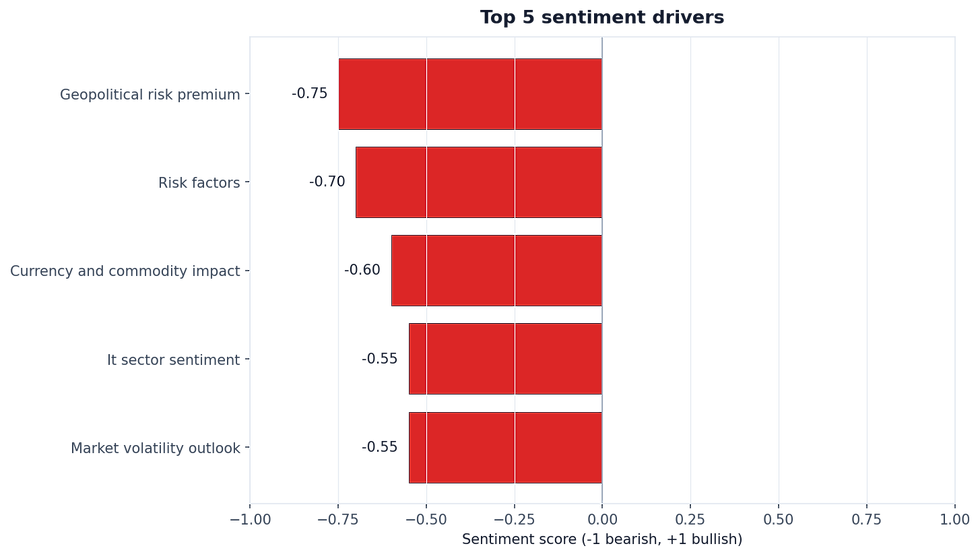
Top 5 sentiment drivers
Geopolitical risk premium. US-Iran tensions remain the single biggest weight on the market today — strongly bearish at -0.75. A reported Iranian assassination threat against former US President Trump has escalated risk perception sharply, and Iran's latest comments have killed hopes of a Strait of Hormuz deal, keeping Brent crude pinned near $90 per barrel and global risk appetite suppressed.
Risk factors. The overall risk environment is strongly bearish at -0.70, combining the Hormuz threat, a weakening rupee at 95.42/USD, and the looming US CPI data release. A crude oil price near $90 per barrel directly threatens India's CAD (Current Account Deficit — the gap between what India earns and spends in foreign exchange), and the Fed's (US Federal Reserve's) rate path remains unclear until tonight's inflation print lands.
Currency and commodity impact. Moderately bearish at -0.60 — the rupee fell 6 paise to 95.42 against the dollar, a level that raises imported inflation concerns since India buys most of its crude in dollars. Gold surged ₹1,200 per 10 grams and silver jumped ₹2,612 per kilogram, signalling that traders are actively hedging against inflation and geopolitical uncertainty rather than buying equities.
IT sector sentiment. Moderately bearish at -0.55, with TCS (Tata Consultancy Services) among the session's top losers and the Nifty IT index underperforming the broader market. The NASDAQ (US tech-heavy stock exchange) is muted ahead of the CPI data, and uncertainty around the Fed's rate trajectory is compressing the valuation multiples (the price investors are willing to pay per rupee of earnings) that Indian IT stocks typically command.
Market volatility outlook. Also moderately bearish at -0.55 — India VIX (Volatility Index, a measure of expected near-term market swings) is likely elevated given the confluence of geopolitical risk, crude near $90, and a major data event pending. The stress is not confined to large caps: 46 Nifty Midcap stocks are currently trading 20–110% below their 52-week highs, pointing to broad-based selling pressure across the market.
Sectors in focus
Banking. Mildly bearish at -0.25 — Bank Nifty is under pressure from the broader selloff and macro headwinds, but Manappuram Finance is a notable exception, surging around 3% after its Q1 (April–June quarter) PAT (Profit After Tax) jumped 4x to ₹585 crore (₹5.85 billion) with gold loan AUM (Assets Under Management — total loans outstanding) nearly doubling. Jefferies and Morgan Stanley both raised their target prices on the stock.
IT. Moderately bearish at -0.55 — this is the weakest sector today. TCS is among the top losers, and without a positive earnings catalyst or a NASDAQ recovery, IT is unlikely to find buyers before the closing bell. The sector's fate for the afternoon is largely tied to any shift in US rate expectations.
Auto & Manufacturing. Mildly bearish at -0.20 — Tata Motors is among the session's top losers, and rising crude oil is a direct input-cost concern for the auto sector. On the brighter side, Ola Electric secured a revised ACC PLI (Advanced Chemistry Cell Production-Linked Incentive — a government scheme rewarding domestic battery manufacturing) timeline targeting ₹7,240 crore (₹72.4 billion) in incentives, a structural positive for EV (electric vehicle) manufacturing.
Pharma & Healthcare. Mildly bearish at -0.15 — the sector is mixed rather than uniformly weak. Zydus Lifesciences fell about 3% after Q1 PAT dropped 36% year-on-year despite 22% revenue growth, though Nuvama upgraded the stock with a higher target. Marksans Pharma delivered a strong 43.6% PAT growth. Apollo Hospitals' Q1 results are still awaited and could move the healthcare index before close.

Global and macro backdrop
Global cues are mixed-to-negative. Japan's Nikkei is trading sideways ahead of the US CPI report, while Chinese equities rose modestly on tech-led gains — a rare bright spot. European markets are set for a flat open despite elevated energy prices driven by Hormuz risk. US Treasury yields have actually fallen today, which normally signals risk-off sentiment (investors moving to safe assets) rather than optimism.
On FII (Foreign Institutional Investor — large overseas funds) and DII (Domestic Institutional Investor — mutual funds, insurance companies, etc.) flows, the picture is negative. FIIs have sold approximately $5.2 billion (around ₹49,500 crore) in FMCG (Fast-Moving Consumer Goods) stocks over the past 12 months, and geopolitical risk is keeping fresh inflows at bay. DIIs are buying selectively — stocks like Lenskart and Delhivery saw the highest DII holding increases in Q1 — but net institutional flow remains negative.
On the domestic regulatory front, SEBI (Securities and Exchange Board of India) proposed a margin framework review for commodity markets, including wider FPI (Foreign Portfolio Investor) access and simpler rules. MCX (Multi Commodity Exchange) jumped 2% following a JPMorgan upgrade tied to this proposal — a rare positive signal in an otherwise red session. The RBI (Reserve Bank of India) organisational structure remains stable with no new policy actions today.
Risks to watch
Hormuz escalation: Any news of actual disruption to oil shipping lanes through the Strait of Hormuz could push crude well above $90 and trigger a fresh leg of selling in the final hour.
US CPI surprise: The July CPI data releases after Indian market hours, but options traders are already pricing in uncertainty — a hotter-than-expected print could gap Nifty lower at tomorrow's open.
Rupee slide: If the rupee weakens further past 95.50/USD, it amplifies imported inflation risk and could accelerate FII outflows.
Pending results: Tata Motors and Apollo Hospitals Q1 results are expected later today — a miss from either could add sector-specific pressure before the closing bell.
What this means for the rest of today's session
The market is unlikely to stage a meaningful recovery in the remaining 2.5 hours unless there is a concrete de-escalation signal from the US-Iran front or crude pulls back sharply. The more probable scenario is continued range-bound trading near current lows, with any late-session volatility driven by Tata Motors or Apollo results. Traders should note that the real market-moving event — the US CPI print — arrives after the Indian close, which means Thursday's open could look very different depending on what that number shows.

How to read this
What this sentiment is measuring. We score 16 distinct dimensions of market sentiment, covering broad market direction, key sectors (banking, IT, auto and manufacturing, pharma), global cues, FII / DII flows, currency and commodities, regulatory stance across India and major foreign jurisdictions, and risk indicators. Each dimension is given a score from −1 (strongly bearish) to +1 (strongly bullish), paired with a 0 to 1 confidence weight that reflects how much supporting evidence the model found. The overall score shown in the dial is a confidence-weighted blend of all dimensions on the same −1 to +1 scale.
What data is used. The analysis draws on Indian and global financial news, regulatory and policy feeds from India as well as major foreign jurisdictions, and market news from global exchanges. News items are filtered for freshness and relevance before being scored, so the picture reflects what the market is reading and reacting to right now.
Limitations. This article is not investment advice and not a recommendation to buy, sell, or hold any security. The output is best treated as a structured attribute set — useful as one input among many when building your own prediction models or sense-checking your own view, not as a forecast on its own.


Comments