Nifty Below 24,200 at Midday: Iran Strikes Keep Bears in Control
- Jul 8
- 5 min read
Based on market data as of 13:04 IST on 08 July 2026.
At a glance
Sensex is down 680 points at 77,502 and Nifty is at 24,207 as of lunchtime, with the morning selloff showing no meaningful reversal.
US military strikes on Iran have spiked crude oil prices and triggered a global risk-off move, hitting Indian markets through currency pressure, higher import costs, and FII (Foreign Institutional Investor) outflows.
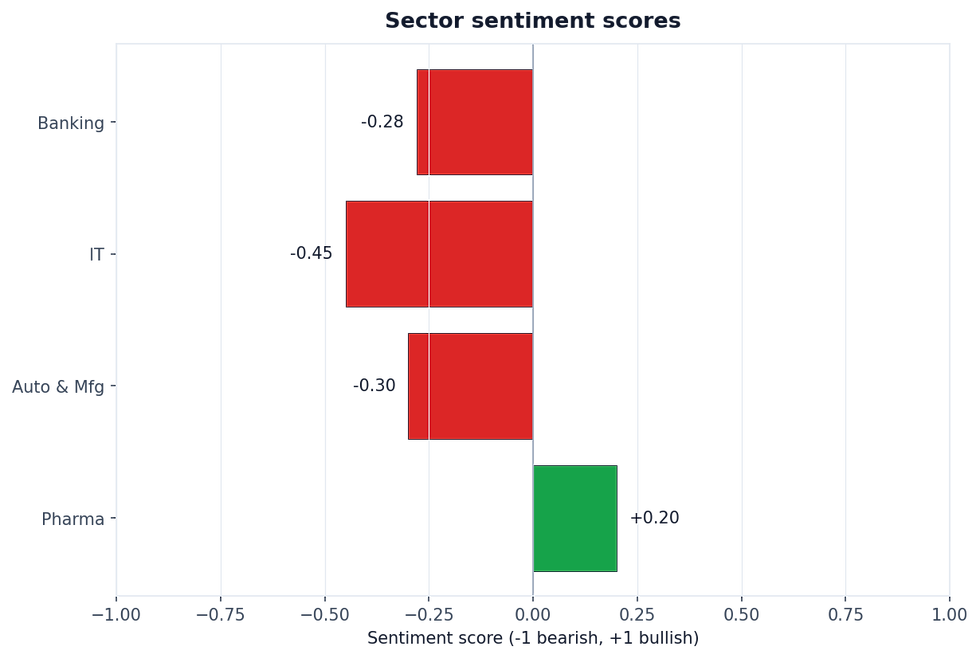
Pharma is the only sector holding positive ground; Banking, IT, and Auto are all under pressure heading into the final two-and-a-half hours of trade.

The setup
Midday on July 8 and the market has found a floor — but not a recovery. The sharp morning gap-down triggered by US military strikes on Iran has largely held, with no meaningful bounce emerging through the first half of the session. New information since the open has not helped: NATO (North Atlantic Treaty Organisation) leaders are still meeting in Ankara, a US-Iran ceasefire remains uncertain, and the rupee has slipped further to 95.16 against the dollar. Domestic positives — NBFC (Non-Banking Financial Company) credit growth at 14.2% and strong Q1 updates from Info Edge and Kalyan Jewellers — are real, but they are simply not large enough to offset a geopolitical shock of this magnitude. The question for the remaining session is whether any ceasefire signal or crude pullback emerges before the closing bell.
Top 5 sentiment drivers
Geopolitical risk premium. US military strikes on Iran are the single dominant shock driving today's session, with Qatar condemning an attack on the vessel Al-Rekayyat near the Strait of Hormuz and NATO leaders still in talks in Ankara — this driver is strongly bearish at -0.82, and until a credible ceasefire signal emerges, it will cap any recovery attempt in the afternoon.
Risk factors. Beyond the strikes themselves, the broader risk picture has worsened since morning: the Fed's (US Federal Reserve's) September rate hike probability has climbed to 63%, the US has revoked Iran's oil sanctions waiver tightening global crude supply, and shipping disruption fears near Hormuz remain unresolved — together these make this driver strongly bearish at -0.78.
Global cues impact. Overnight, the Nasdaq sold off as rising oil prices and Treasury yields dragged AI and tech stocks lower; the Nikkei followed in volatile trade, and European markets opened weaker on the energy price surge — this global risk-off cascade is moderately bearish at -0.68 and has directly suppressed FII appetite for Indian equities through the morning.
Currency and commodity impact. The rupee has fallen 20 paise to 95.16 against the US dollar, reflecting both crude-driven import cost fears and a stronger dollar index — notably, gold has fallen for a third straight session despite the geopolitical tension, suggesting rate hike expectations are overriding safe-haven demand; this driver is moderately bearish at -0.65 and adds direct pressure on India's current account deficit.
Market volatility outlook. India VIX (Volatility Index — a measure of expected market turbulence derived from Nifty options prices) is likely elevated given the 680-point Sensex fall; Bitcoin slipping below $63,000 confirms broad risk aversion across asset classes, and the options market is pricing in elevated premiums for the rest of the session — this driver is moderately bearish at -0.60, meaning sharp intraday swings remain possible through the close.

Sectors in focus
Banking. Mildly bearish at -0.28 — NBFC credit growth accelerating to 14.2% in May 2026 is a genuine structural positive, but rising Fed rate hike expectations at 63% probability are pressuring valuations, and South Indian Bank's 9% fall post a four-day rally is a reminder that individual stock risk remains elevated even within a broadly resilient sector.
IT. Moderately bearish at -0.45 — the Nasdaq selloff overnight has dragged global tech sentiment lower, and TCS's Q1 preview points to only modest profit growth amid weak client spending and AI-led disruption concerns; Info Edge's 19% surge on 14% standalone billings growth is a bright outlier but is not enough to lift the broader sector.
Auto & Manufacturing. Mildly bearish at -0.30 — Q1 revenue growth for auto companies looks strong, but rising commodity costs from the crude surge are squeezing margins; Maruti Suzuki's 1.65% fall after a ₹9.5 crore (₹9,50,00,000) customs duty demand adds a company-specific headwind on top of the macro pressure.
Pharma. Mildly bullish at +0.20 — pharma is the session's defensive standout, with Marksans Pharma's acquisition of Germany-based ABCnow GmbH signalling international expansion and Navi Mumbai Airport's designation as a drug import port improving supply chain efficiency; the sector's low oil sensitivity makes it a relative safe harbour today.
Global and macro backdrop
The global backdrop remains firmly risk-off. US Treasury yields have risen alongside oil prices, a combination that historically pressures equity valuations — particularly in rate-sensitive sectors. The dollar index has strengthened on inflation concerns stemming from the Iran sanctions waiver revocation, which directly tightens global crude supply. FII flows are modestly negative, with the rupee's 20-paise decline to 95.16 serving as a proxy signal; DII (Domestic Institutional Investor) buying appears to be absorbing some of the selling, which explains why the market has not fallen further than the morning lows. SEBI (Securities and Exchange Board of India) has mandated that FPI (Foreign Portfolio Investor) fee payments be made in Indian rupees — a minor regulatory change, but one that adds a small friction cost for foreign investors. European markets opened lower and NATO's Ankara meeting has yet to produce any de-escalation signal. On the domestic macro side, India's regulatory environment remains stable and NBFC credit growth provides a constructive undercurrent, but neither is powerful enough to shift the session's direction on its own.
Risks to watch
Ceasefire breakdown: Any news of further US or Iranian military action near the Strait of Hormuz could push crude higher and trigger another leg down in the final two hours.
Crude oil spike: Brent crossing a key psychological level in afternoon trade would amplify rupee weakness and widen India's import cost concerns.
Fed commentary: Any hawkish remarks from US Fed officials reinforcing the 63% September rate hike probability could add pressure on rate-sensitive banking and real-estate stocks.
Options expiry positioning: Elevated VIX means large options positions could force sharp moves in either direction as market makers adjust hedges near the close.
What this means for the rest of today's session
With roughly two and a half hours left, the market's direction hinges almost entirely on geopolitical headlines. The morning selloff has stabilised rather than deepened — a sign that DII support is present — but there is no catalyst visible right now for a meaningful recovery. If the NATO Ankara talks produce even a tentative ceasefire signal, expect a sharp short-covering bounce, particularly in oil-sensitive sectors. Absent that, the path of least resistance is sideways-to-lower, with Nifty likely to close in the 24,150–24,250 range. Investors should watch crude oil prices and any Iran-related headlines in real time as the primary lead indicators for the closing hour.

How to read this
What this sentiment is measuring. We score 16 distinct dimensions of market sentiment, covering broad market direction, key sectors (banking, IT, auto and manufacturing, pharma), global cues, FII / DII flows, currency and commodities, regulatory stance across India and major foreign jurisdictions, and risk indicators. Each dimension is given a score from −1 (strongly bearish) to +1 (strongly bullish), paired with a 0 to 1 confidence weight that reflects how much supporting evidence the model found. The overall score shown in the dial is a confidence-weighted blend of all dimensions on the same −1 to +1 scale.
What data is used. The analysis draws on Indian and global financial news, regulatory and policy feeds from India as well as major foreign jurisdictions, and market news from global exchanges. News items are filtered for freshness and relevance before being scored, so the picture reflects what the market is reading and reacting to right now.
Limitations. This article is not investment advice and not a recommendation to buy, sell, or hold any security. The output is best treated as a structured attribute set — useful as one input among many when building your own prediction models or sense-checking your own view, not as a forecast on its own.


Comments