June 12 Rally Recap: Crude Crash Lifts Markets, But Hormuz Risk Lingers Into Monday
- Jun 14
- 6 min read
Based on market data as of 07:05 IST on 14 June 2026.
At a glance
Nifty surged roughly 2% on June 12, powered by US-Iran ceasefire optimism and a sharp 4.1% drop in Brent crude oil prices.
SEBI (Securities and Exchange Board of India) and RBI (Reserve Bank of India) rolled out a wave of investor-friendly reforms, boosting the regulatory outlook for capital markets.
GIFT Nifty — the offshore futures contract that previews the Indian market open — was down 135 points as of Sunday morning, signalling a cautious start when markets reopen on June 15.

The setup
June 12 was a strong session by any measure, but the holiday pause gives investors a chance to look past the headline rally and weigh what lies ahead. The 2% surge was largely event-driven — ceasefire hopes between the US and Iran briefly lifted sentiment across global markets and hammered crude prices. That is unambiguously good for India, a major oil importer. Yet the Strait of Hormuz remains an active conflict zone, Iranian forces attacked vessels crewed by Indian nationals, and Washington has issued a direct diplomatic warning to New Delhi. As markets reopen on June 15, the overall sentiment score sits at a moderately positive +0.32 out of +1.0 — constructive, but not comfortably so.
Top 5 sentiment drivers
India regulatory stance. SEBI approved three new IPOs (initial public offerings) — Bombay Coated, Bonfiglioli, and Swaraj Green Power — and is evaluating long-term F&O (Futures and Options) contracts to deepen capital markets, easing KYC (Know Your Customer) rules for FPIs (Foreign Portfolio Investors), and reviewing the delisting framework. RBI's revival of the FCNR(B) — Foreign Currency Non-Resident (Banks) — deposit scheme targets $50–100 billion in fresh debt inflows. Together, these moves are strongly bullish at +0.60, signalling that regulators are actively working to attract global capital.
Geopolitical risk premium. Iran attacked commercial vessels crewed by Indian nationals in the Strait of Hormuz, killing three people, while the US Navy downed Iranian drones targeting ships in the same waterway. The US has also formally warned India against violating the Hormuz blockade on Iranian oil, adding a bilateral diplomatic dimension. This driver is meaningfully bearish at -0.50 and is the single biggest cloud over an otherwise improving picture.
FII/DII flow sentiment. FII (Foreign Institutional Investor) and DII (Domestic Institutional Investor) flow signals are mildly bullish at +0.55. SEBI's KYC simplification for FPIs and the revised common application form reduce registration friction for global funds. RBI's FCNR(B) push, if successful, could channel tens of billions of dollars into Indian debt markets over time. Three fresh IPO approvals also point to healthy domestic appetite from retail and DII participants.
Global cues impact. Wall Street closed the week on a positive note — the S&P 500 gained 0.5% for its tenth winning week in eleven, the Dow Jones rose 0.76%, and the NASDAQ added 0.7%, partly lifted by SpaceX's blockbuster Nasdaq debut at a 29% premium to its issue price. Brent crude's 4.1% weekly decline was the standout macro event. The overall global cues score is mildly bullish at +0.50, though the GIFT Nifty's -135-point reading tempers direct enthusiasm for Monday's open.
Currency and commodity impact. The crude oil decline is the most direct positive for India's economy — lower Brent prices reduce the country's oil import bill and help narrow the CAD (Current Account Deficit). The US dollar weakened on Iran deal optimism, which supports INR (Indian Rupee) stability. Gold fell for a second consecutive week on expectations of higher interest rates. This driver scores mildly bullish at +0.45, with the Hormuz supply-risk overhang the key caveat.

Sectors in focus
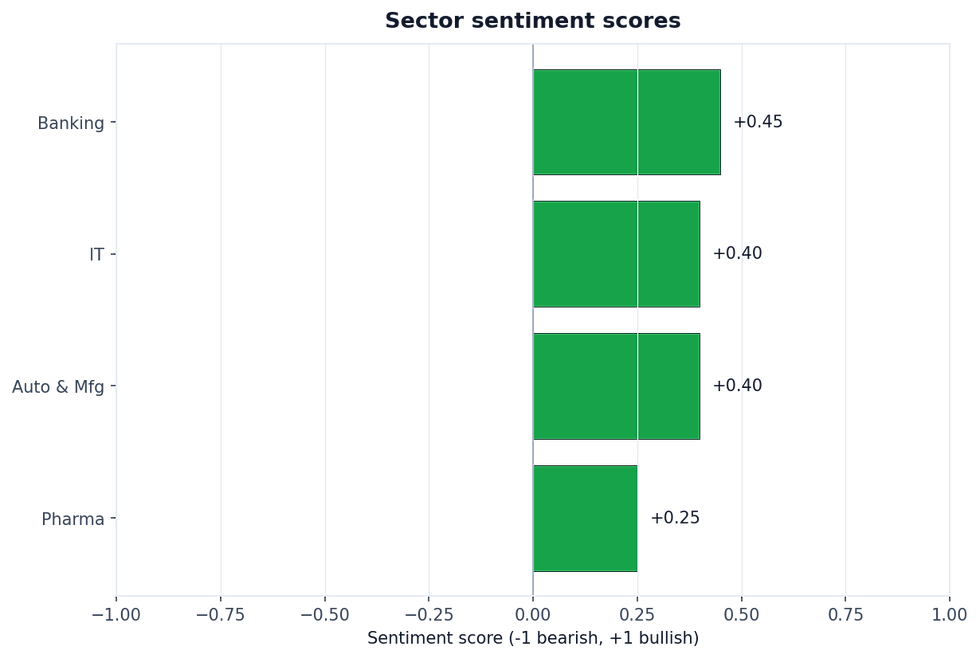
Banking. Mildly bullish at +0.45 — Bank Nifty participated in the broader June 12 rally, and RBI's FCNR(B) push is a structural positive for banking sector liquidity. HDFC Bank featured in bullish F&O strategy calls. However, microfinance lenders face rising credit stress linked to a weak monsoon, creating a clear divergence within the sector.
IT. Mildly bullish at +0.40 — the NASDAQ's weekly gain and SpaceX's $2.1-trillion debut provide a positive global tech backdrop that indirectly supports Indian IT majors like TCS, Infosys, and Wipro. Sterlite Tech appeared in bullish F&O picks. Dollar weakness is a mild headwind for IT exporters who earn in USD, though no major Indian IT earnings catalyst is visible this week.
Auto and Manufacturing. Mildly bullish at +0.40 — Tata Motors and Ashok Leyland were among the top gainers on June 12, directly benefiting from the crude price decline that reduces input and fuel costs. Haryana's ₹913 crore (approximately ₹9.13 billion) power sector investment supports manufacturing capex sentiment. A reported shutdown risk at Tata Electronics' Hosur iPhone parts plant is a company-specific negative to monitor.
Pharma. Cautiously positive at +0.25 — the sector's score is the weakest of the four. Aurobindo Pharma's Eugia Unit-III received an OAI (Official Action Indicated) classification from the USFDA (US Food and Drug Administration), a serious regulatory flag that could lead to an import alert and hurt US revenue. Torrent Pharma's strong domestic growth and JB Chemicals acquisition synergies offer a partial offset, but the Aurobindo development will likely weigh on the broader pharma index at Monday's open.
Global and macro backdrop
Global equity markets ended the week in positive territory, driven largely by optimism around a potential US-Iran Memorandum of Understanding (MoU) that could ease Hormuz tensions. Brent crude's 4.1% decline was the most consequential macro move for India, directly improving the country's energy import economics. The US dollar's weekly loss supports a relatively stable INR, reducing imported inflation pressure. On the FII/DII flow front, SEBI's regulatory reforms are designed to lower barriers for foreign capital entry, and early signals suggest institutional interest remains intact. EU-Ukraine membership talks add a layer of geopolitical complexity to European markets but have limited direct impact on India. China's regulatory stance remains a low-signal, mildly positive backdrop at +0.10. The Fed's (US Federal Reserve's) hawkish posture — reflected in gold's second consecutive weekly decline — is a reminder that global rate conditions are not yet easing.
Risks to watch
Hormuz escalation: Active military conflict in the Strait of Hormuz, Iranian attacks on Indian-crewed vessels, and US diplomatic pressure on India over blockade compliance remain the most immediate tail risk for markets and the INR.
GIFT Nifty signal: The -135-point reading heading into the weekend suggests Monday's open could give back a portion of Friday's gains, particularly if no positive ceasefire update emerges over the weekend.
Aurobindo USFDA action: An OAI classification that escalates to an import alert could trigger a sharp move in Aurobindo Pharma and drag on the broader pharma index.
Microfinance credit stress: Weak monsoon conditions are increasing default risk in the microfinance segment, which could surface as an earnings headwind for smaller banks and NBFCs (Non-Banking Financial Companies) in coming quarters.
What this means for the next session
When markets reopen on June 15, the tone will likely be shaped by two competing forces: the constructive regulatory backdrop from SEBI and RBI on one side, and the Hormuz conflict overhang plus the GIFT Nifty's cautious signal on the other. The overall sentiment score of +0.32 reflects exactly this tug-of-war — moderately positive, but with enough risk premium to keep sharp upside moves in check. Investors would do well to watch for any weekend developments on the US-Iran MoU, crude oil price direction in Asian trading hours, and any USFDA follow-up on the Aurobindo situation before drawing conclusions about Monday's trajectory.
_Note: Freshness check skipped. Data is from 2026-06-14 07:05 IST._

How to read this
What this sentiment is measuring. We score 16 distinct dimensions of market sentiment, covering broad market direction, key sectors (banking, IT, auto and manufacturing, pharma), global cues, FII / DII flows, currency and commodities, regulatory stance across India and major foreign jurisdictions, and risk indicators. Each dimension is given a score from −1 (strongly bearish) to +1 (strongly bullish), paired with a 0 to 1 confidence weight that reflects how much supporting evidence the model found. The overall score shown in the dial is a confidence-weighted blend of all dimensions on the same −1 to +1 scale.
What data is used. The analysis draws on Indian and global financial news, regulatory and policy feeds from India as well as major foreign jurisdictions, and market news from global exchanges. News items are filtered for freshness and relevance before being scored, so the picture reflects what the market is reading and reacting to right now.
Limitations. This article is not investment advice and not a recommendation to buy, sell, or hold any security. The output is best treated as a structured attribute set — useful as one input among many when building your own prediction models or sense-checking your own view, not as a forecast on its own.


Comments