GIFT Nifty Signals Weak Open as Iran Strikes Push Crude Above $76
- Jul 8
- 5 min read
Based on market data as of 07:05 IST on 08 July 2026.
At a glance
GIFT Nifty is pointing to a negative open for Indian markets on July 8, driven by US military strikes on Iran and a sharp surge in Brent crude above $76/barrel.
Trent's 12%-plus post-results decline adds domestic pressure, while Nasdaq weakness from AI and chip concerns weighs on the IT sector.
The rupee's recent strength at 94.96 and accelerating NBFC (Non-Banking Financial Company) credit growth of 14.2% year-on-year offer limited but real cushions.

The setup
Good morning. Before the opening bell rings today, the picture is decidedly cautious. Overnight, the United States launched military strikes on Iran, and Iran's IRGC (Islamic Revolutionary Guard Corps) responded with missile attacks on commercial vessels in the Strait of Hormuz — a critical global oil shipping lane. Brent crude, the international oil benchmark, has surged above $76 per barrel. GIFT Nifty (the offshore futures contract that tracks the Nifty 50 and serves as an early indicator of how Indian markets will open) is already pointing lower. Add Nasdaq weakness and a domestic earnings disappointment from Trent, and today's session calls for careful attention rather than quick moves.
Top 5 sentiment drivers
Geopolitical risk premium. US military strikes on Iran and IRGC missile attacks on vessels in the Strait of Hormuz have sharply elevated global risk sentiment overnight; Brent crude surging above $76/barrel directly raises India's import bill, and this driver is strongly bearish at -0.75.
Risk factors. Multiple headwinds are converging simultaneously — active Middle East conflict, US-reinstated sanctions on Iranian oil, a spike in India's 10-year bond yield (its largest climb in two weeks), and Nifty 50 Q1 FY27 profit growth expected to come in at single-digit levels; collectively, this is strongly bearish at -0.65.
Global cues impact. Wall Street closed in the red overnight, with the S&P 500 and Nasdaq both falling on AI and chip concerns — Intel dropped 8.2%, Micron shed 7.3%, and Nvidia slipped 1.8%; the dollar hit a week-high after the Iran strikes, adding pressure on emerging-market currencies including the rupee, making this driver moderately bearish at -0.55.
Market volatility outlook. India VIX (Volatility Index — a measure of expected near-term market swings; a rising VIX signals more fear) is likely to spike today given the combination of geopolitical shock, crude oil surge, Nasdaq weakness, and Trent's sharp 12%-plus post-results decline; options markets will price in a higher risk premium, making this driver moderately bearish at -0.50.
US regulatory stance. The US has reinstated sanctions on Iranian oil sales, directly amplifying the crude price spike; separately, the Federal Reserve (the US central bank) proposed amendments to AML (Anti-Money Laundering) programme requirements for banks, while the FCC (Federal Communications Commission) denied a Chinese-linked firm telecoms approval; the 10-year US yield is expected to ease slightly to 6.64% as Fed rate-hike bets soften — overall mildly bearish at -0.45.

Sectors in focus
Banking. Mildly bearish at -0.25 — the RBI's (Reserve Bank of India's) new SMS alert order could reduce banks' non-interest income by around ₹300 crore (₹3 billion), and a spike in India's 10-year bond yield pressures bond portfolios, though the RBI's ₹25,000 crore (₹250 billion) VRR (Variable Rate Repo — a short-term liquidity tool) auction signals active liquidity management and NBFC credit growth of 14.2% YoY (year-on-year) is a healthy underlying signal.
IT. Moderately bearish at -0.40 — Nasdaq's overnight decline driven by Intel's 8.2% fall, Micron's 7.3% drop, and DeepSeek's AI chip push rattling semiconductor sentiment will likely drag Nifty IT lower at open; the sector had rallied on July 7 but global cues have now turned decisively negative for technology stocks.
Auto and Manufacturing. Mildly bullish at +0.10 — the Centre's mandate for OEMs (Original Equipment Manufacturers) to audit connected-vehicle software and battery systems provides regulatory clarity, and NBFC credit growth supports auto financing demand; however, crude oil above $76 is a real input-cost headwind that limits upside for the sector today.
Pharma and Healthcare. Mildly bullish at +0.15 — with broader markets under pressure, pharma tends to attract defensive rotation (investors moving into stable, less cyclical sectors during uncertainty); there are no negative USFDA (US Food and Drug Administration) actions in current news flow, and Glenmark Pharma is on the stocks-to-watch list for today's session.

Global and macro backdrop
Wall Street ended Tuesday's session in negative territory. The S&P 500 and Nasdaq both fell, led by chip stocks reacting to Samsung AI developments and DeepSeek's competitive push. The dollar index climbed to a week-high following the Iran strikes, which typically pressures FII (Foreign Institutional Investor — overseas funds investing in Indian markets) inflows into emerging markets like India.
On the currency front, the rupee had a strong July 7, gaining 48–50 paise to close at 94.96 against the US dollar — its best single-day move in three weeks, helped by NDF (Non-Deliverable Forward — an offshore currency derivative market) dollar selling. That rupee strength is a partial positive for today, but a sustained dollar rally could erode it.
DII (Domestic Institutional Investor — Indian mutual funds, insurance companies, and similar entities) buying capacity remains solid, supported by accelerating NBFC credit growth. However, FII flows face headwinds from dollar strength and elevated geopolitical uncertainty. Asian markets are expected to open cautiously, broadly reflecting the same overnight pressures.
On the domestic regulatory side, SEBI (Securities and Exchange Board of India) eased rules on depository investor protection fund income usage, and the RBI launched its 115th round of the Industrial Outlook Survey for Q2 FY27 — both mildly constructive signals for the medium term.
Risks to watch
Hormuz escalation: Any further IRGC attacks on commercial vessels or a formal blockade of the Strait of Hormuz could push Brent crude significantly higher, worsening India's current account deficit.
Trent contagion: Trent's 12%-plus decline after Q1 results could trigger broader selling in consumer discretionary and retail stocks today.
VIX spike and options expiry dynamics: A sharp rise in India VIX could trigger stop-losses and amplify intraday swings beyond what fundamentals justify.
Rupee reversal risk: If the dollar continues to strengthen on safe-haven demand post-Iran strikes, the rupee's recent gains could reverse quickly, adding to import-cost pressures.
What this means for today's session
Today's session is set to open under pressure, and the first hour will be the most important one to watch. GIFT Nifty's negative signal, crude above $76, and a weak Wall Street close give bears the early advantage. Defensive sectors like pharma may see relative outperformance, while IT and consumer discretionary face the sharpest headwinds. The rupee's resilience and DII buying appetite are the two factors most likely to determine whether the market finds a floor during the day — or whether selling deepens into the afternoon.
How to read this
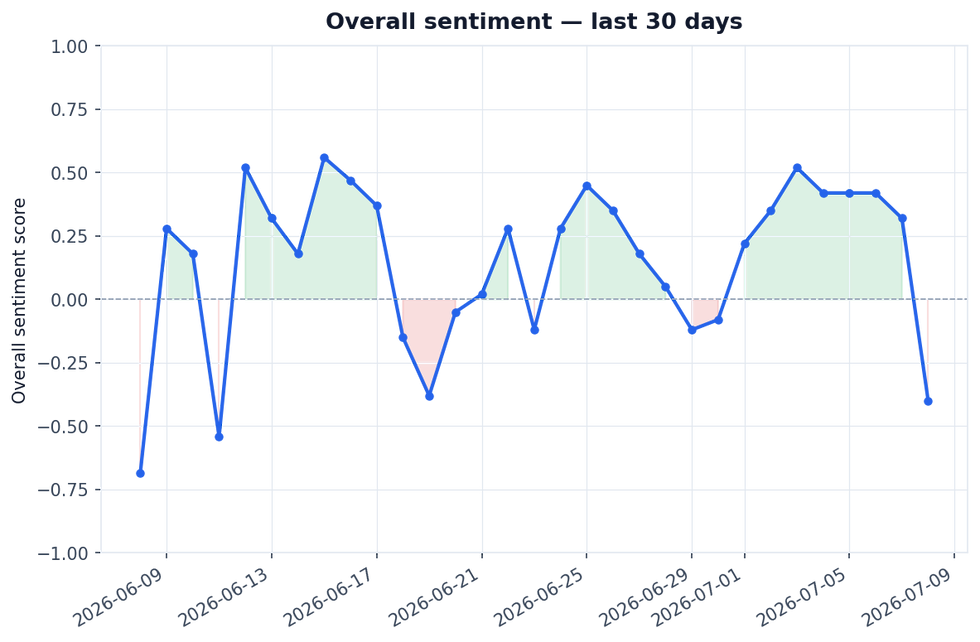
What this sentiment is measuring. We score 16 distinct dimensions of market sentiment, covering broad market direction, key sectors (banking, IT, auto and manufacturing, pharma), global cues, FII / DII flows, currency and commodities, regulatory stance across India and major foreign jurisdictions, and risk indicators. Each dimension is given a score from −1 (strongly bearish) to +1 (strongly bullish), paired with a 0 to 1 confidence weight that reflects how much supporting evidence the model found. The overall score shown in the dial is a confidence-weighted blend of all dimensions on the same −1 to +1 scale.
What data is used. The analysis draws on Indian and global financial news, regulatory and policy feeds from India as well as major foreign jurisdictions, and market news from global exchanges. News items are filtered for freshness and relevance before being scored, so the picture reflects what the market is reading and reacting to right now.
Limitations. This article is not investment advice and not a recommendation to buy, sell, or hold any security. The output is best treated as a structured attribute set — useful as one input among many when building your own prediction models or sense-checking your own view, not as a forecast on its own.


Comments